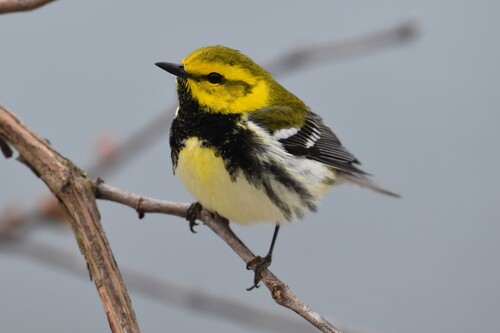


Black-Throated Green Warbler
setophaga virens
The Black-throated Green Warbler is a small, energetic songbird known for its buzzing, persistent song that heralds the arrival of spring in the coniferous and mixed forests of eastern North America. Admired by birdwatchers for its vibrant plumage and relentless activity, this warbler spends most of its time high in the forest canopy, actively foraging for insects. During the breeding season, its classic song can be heard echoing through the pines, making it a beloved symbol of northern woodlands.
Hábitat: Found in mature coniferous and mixed forests, particularly those dominated by hemlock, spruce, or pine.
Adults have an olive-green back, a bright yellow face, and a distinctive black throat and upper breast that contrasts sharply with their white underparts and greenish-yellow flanks. They feature two bold white wingbars on their dark wings. Females and immatures have a similar pattern but with a much paler, speckled, or entirely yellow throat instead of solid black.
Categoría
AvesRareza
Common
Peligro
1/5 · Muy bajo
Snaps
¡Sé la primera persona en hacer un snap!
Despite their small size, they migrate thousands of miles each year between their North American breeding grounds and Central American wintering sites.
During migration, some individuals stray far off course, occasionally turning up as rare vagrants in western Europe.
Males have two distinct songs: one used primarily to attract females, and another used to defend nesting territory against other males.
They can hover momentarily in mid-air to pluck insects off the undersides of leaves and needles.
Males are famous for singing up to 400 times an hour during the peak of the breeding season to defend territories.
With lightweight bodies and sharp claws, they effortlessly hop and cling to the thin, outermost twigs of high tree canopies.
Feeds primarily on insects and other small invertebrates gleaned from tree foliage, occasionally eating berries.
Diferencias por edad: Nestlings are fed exclusively high-protein insects and larvae, while adults may occasionally eat berries during migration.
Vireo solitarius
Competes for nesting sites and insect resources in the upper canopy.
Megascops asio
Preys upon small songbirds including warblers during the nesting season.
Choristoneura fumiferana
Serves as a major food source, especially during seasonal outbreaks.
Aún no hay insignias de rasgos asignadas a este objeto.
Todavía no hay alias listados.
Las colecciones para este objeto aparecerán aquí a medida que se añadan más temas.
Peligro
1/5 · Muy bajo
Todavía no hay notas especiales de seguridad.
La forma más fácil de identificar a Black-Throated Green Warbler es usar la aplicación de identificación de naturaleza Snappit.
11-13 cm
17-20 cm
0.007-0.011 kg
1-7 años
40 km/h
Feeds primarily on insects and other small invertebrates gleaned from tree foliage, occasionally eating berries.
Found in mature coniferous and mixed forests, particularly those dominated by hemlock, spruce, or pine.
Acércate para separar los grupos y explorar dónde se ha fotografiado este objeto.
Los snaps recientes aparecerán aquí a medida que se añadan nuevas observaciones.














