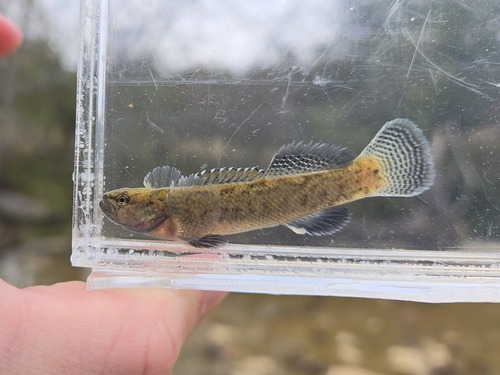


Blackfin Darter
etheostoma nigripinne
The Blackfin Darter is a charming, bottom-dwelling freshwater fish native to the Tennessee River basin in the southeastern United States. These small, slender fish are members of the perch family and are renowned for their active hopping movements along stream beds rather than sustained swimming. During the spring breeding season, males undergo a dramatic color transformation, developing striking dark fins that give the species its common name. Observing these miniature spectacles of nature offers a glimpse into the rich, hidden biodiversity of North American aquatic ecosystems. Their presence is a great indicator of clean, well-oxygenated stream habitats.
Hábitat: Found in small- to medium-sized rocky creeks and headwater streams, typically preferring shallow pools or slow-flowing riffles with plentiful gravel, cobble, or flat rocks for shelter.
The Blackfin Darter is a small, elongated fish reaching about 5 to 8 centimeters in length. It features a mottled brown or tan body with darker saddle-like bands across its back, providing excellent camouflage against gravelly stream bottoms. Breeding males are particularly distinctive, showcasing darkened pelvic and anal fins, along with a prominent black pigment band on their dorsal fins. They possess a blunt snout and large, upward-looking eyes adapted for surveying the water column for tiny prey.
Categoría
PecesRareza
Common
Peligro
1/5 · Muy bajo
Snaps
¡Sé la primera persona en hacer un snap!
Spawning pairs lay their eggs on the undersides of flat rocks, and males aggressively defend the nesting territory from intruders.
Their movement style has been compared to a frog's leap, utilizing quick darting bursts followed by motionless pauses.
Unlike many typical fish, Blackfin Darters lack a functional swim bladder, which keeps them sinking to the stream bed where they live.
Using enlarged pectoral fins, the darter hops along the stream bed rather than swimming, saving energy in fast currents.
During spawning, males rapidly develop deep black pigmentation on their fins to signal maturity and attract females.
Their intricate mottled pattern breaks up their silhouette, making them nearly invisible to overhead predators like herons.
Feeds primarily on small benthic macroinvertebrates, especially aquatic insect larvae, which they pick from the substrate.
Diferencias por edad: Juveniles consume smaller microcrustaceans such as copepods, transitioning to larger insect larvae as they mature.
Ambloplites rupestris
Acts as a prey item for larger predatory fish in headwater streams.
Stenonema femoratum
Consumes abundant larvae of mayflies living under stones.
Etheostoma flabellare
Shares similar rocky stream habitats and feeds on the same benthic invertebrates.
Aún no hay insignias de rasgos asignadas a este objeto.
Todavía no hay alias listados.
Las colecciones para este objeto aparecerán aquí a medida que se añadan más temas.
Peligro
1/5 · Muy bajo
Todavía no hay notas especiales de seguridad.
La forma más fácil de identificar a Blackfin Darter es usar la aplicación de identificación de naturaleza Snappit.
5-8 cm
0.001-0.005 kg
2-3 años
Feeds primarily on small benthic macroinvertebrates, especially aquatic insect larvae, which they pick from the substrate.
Found in small- to medium-sized rocky creeks and headwater streams, typically preferring shallow pools or slow-flowing riffles with plentiful gravel, cobble, or flat rocks for shelter.
Foraging
10-20 días
Acércate para separar los grupos y explorar dónde se ha fotografiado este objeto.
Los snaps recientes aparecerán aquí a medida que se añadan nuevas observaciones.















