

Blacklegged Tortoise Beetle
jonthonota nigripes
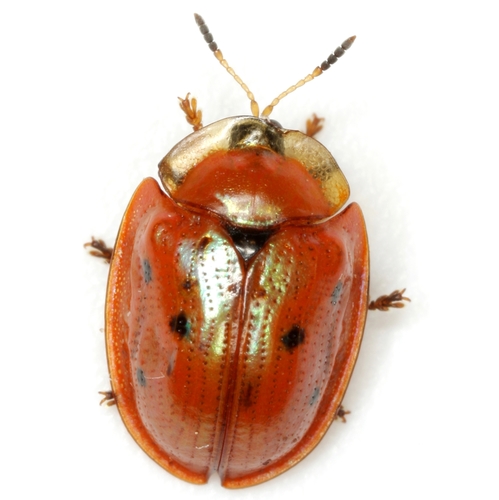
The Blacklegged Tortoise Beetle is a fascinating and colorful insect belonging to the leaf beetle family. This tiny, dome-shaped marvel is widely recognized for its unique tortoise-like shell and its striking orange-to-gold coloring contrasted by solid black legs. Found throughout North America, it is often seen clinging to the leaves of sweet potatoes, bindweed, and morning glories, which serve as both its nursery and primary food source. What makes this species truly remarkable is its range of quirky survival mechanisms. While adults rely on a hard, flat-rimmed shell that they can suction tightly against leaves to avoid predators, their larvae employ an even more unusual tactic: a fecal shield built from dried waste and shed skins to ward off hungry birds and spiders.
Hábitat: Typically found in agricultural fields, suburban gardens, and weedy roadsides where morning glories and bindweeds grow abundantly.
This small beetle, ranging from 7 to 9 millimeters in length, features a distinct hemispherical body that resembles a miniature turtle shell. Its pronotum and elytra are broad and flanged with translucent margins that cover the head and legs from view. The upper body is typically a vivid reddish-orange or golden-yellow, punctuated by small, black spots, most notably three distinct spots on each elytron. True to its name, its legs and the undersides of its body are a solid, contrasting black, which immediately distinguishes it from other similar golden tortoise beetles.
Categoría
InsectosRareza
Common
Peligro
1/5 · Muy bajo
Snaps
¡Sé la primera persona en hacer un snap!
Despite their rigid appearance, adults are capable fliers and will quickly take flight if warmth and sunlight permit.
Larval fecal shields aren't just for physical blocking; they contain chemicals derived from the toxic host plants, making them chemically repellent to predators.
The translucent margins of its elytra act like a shield, protecting the beetle's vulnerable limbs from attacking ants.
Larvae carry a protective shield of dried feces and cast skins on a specialized anal fork, waving it to scare away or physically block predators.
When threatened, adult beetles pull their legs and head under their wide, flat margins and press themselves tightly against a leaf surface, making it difficult for predators to flip them over.
The beetle can manipulate fluids in its exoskeleton to shift its color from a brilliant, metallic gold when active and hydrated to a duller orange-red when disturbed or dry.
Both larvae and adults feed strictly on the foliage of plants in the morning glory family, chewing distinctive round holes in the leaves.
Diferencias por edad: Young larvae skeletonize the lower leaf surface, while older larvae and adults chew holes completely through the leaves.
Ipomoea purpurea
Serves as a primary larval host and food source for the beetle.
Podisus maculiventris
Predatory bug that feeds on both the larvae and pupae of the tortoise beetle.
Convolvulus arvensis
Alternative wild host plant where adult beetles feed and deposit eggs.
Aún no hay insignias de rasgos asignadas a este objeto.
Todavía no hay alias listados.
Las colecciones para este objeto aparecerán aquí a medida que se añadan más temas.
Peligro
1/5 · Muy bajo
Todavía no hay notas especiales de seguridad.
La forma más fácil de identificar a Blacklegged Tortoise Beetle es usar la aplicación de identificación de naturaleza Snappit.
0+ cm
1+ cm
0+ kg
1+ años
3 km/h
Both larvae and adults feed strictly on the foliage of plants in the morning glory family, chewing distinctive round holes in the leaves.
Typically found in agricultural fields, suburban gardens, and weedy roadsides where morning glories and bindweeds grow abundantly.
Acércate para separar los grupos y explorar dónde se ha fotografiado este objeto.
Los snaps recientes aparecerán aquí a medida que se añadan nuevas observaciones.