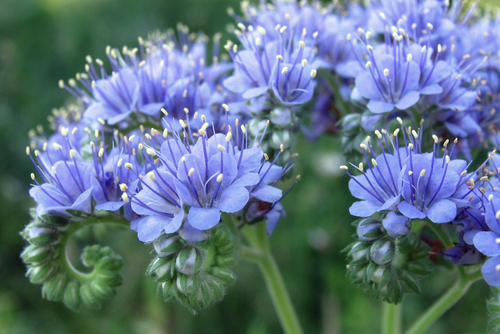


Blue Curls
phacelia congesta
Phacelia congesta, commonly known as Blue Curls or spike phacelia, is a striking herbaceous annual plant native to the southern United States, particularly Texas, and northern Mexico. Known for its tightly coiled, fiddlehead-like flower clusters, this plant adds a vibrant burst of blue-violet color to the landscape during the spring and early summer. As a member of the borage family, it plays a vital ecological role by attracting a diverse array of pollinators, including bees, butterflies, and hoverflies, with its nectar-rich blossoms. It typically thrives in dry, sandy, or rocky soils, showcasing its resilience in challenging, sun-baked environments.
Hábitat: Typically found in open woodlands, prairies, rocky slopes, and disturbed areas like roadsides with dry, well-drained sandy or limestone soils.
Blue Curls is characterized by its erect, hairy stems that can reach heights of 30 to 90 centimeters. The most distinctive feature is its terminal scorpioid cymes—coiled flower clusters resembling the tail of a scorpion—which gradually unfurl as the small, bell-shaped flowers bloom. Each blossom is typically lavender, blue, or violet, featuring protruding, creamy-white stamens that give the cluster a fuzzy or delicate appearance. The leaves are deeply lobed or pinnately divided, covered in fine, stiff hairs that can sometimes cause mild skin irritation when touched.
Categoría
PlantasRareza
Common
Peligro
1/5 · Muy bajo
Snaps
¡Sé la primera persona en hacer un snap!
Its fuzzy, prominent stamens give the flowers a bearded appearance, which is why some species in the genus are colloquially called scorpion-weeds.
The name 'Phacelia' is derived from the Greek word 'phakelos', meaning bundle, which refers to the crowded, bundled appearance of its flowers.
The unique coiled shape of its flower head is called a helicoid or scorpioid cyme because it resembles a scorpion's curled tail.
The floral cluster is tightly coiled to protect immature buds, unfurling sequentially to ensure a prolonged blooming period and continuous pollination.
Stiff, fine hairs covering the stems and leaves reduce water loss by trapping a boundary layer of moisture and deterring herbivores.
Produces copious amounts of high-quality nectar and pollen, specifically timed to attract native bees and butterflies when other resources are scarce.
As a photoautotrophic plant, Blue Curls produces its own organic compounds using sunlight, carbon dioxide, water, and essential soil minerals through photosynthesis.
Diferencias por edad: As a seedling, it relies on stored seed reserves before establishing a root system to absorb soil nutrients and initiate photosynthesis.
Apis mellifera
Pollinated by adult bees seeking nectar and pollen.
Odocoileus virginianus
The leaves and stems are occasionally grazed by native herbivores, although the hairy texture deters many.
Danaus plexippus
Nectar source for butterflies seeking quick energy during spring migrations.
Aún no hay insignias de rasgos asignadas a este objeto.
Todavía no hay alias listados.
Las colecciones para este objeto aparecerán aquí a medida que se añadan más temas.
Peligro
1/5 · Muy bajo
Todavía no hay notas especiales de seguridad.
La forma más fácil de identificar a Blue Curls es usar la aplicación de identificación de naturaleza Snappit.
30-90 cm
1 años
As a photoautotrophic plant, Blue Curls produces its own organic compounds using sunlight, carbon dioxide, water, and essential soil minerals through photosynthesis.
Typically found in open woodlands, prairies, rocky slopes, and disturbed areas like roadsides with dry, well-drained sandy or limestone soils.
Acércate para separar los grupos y explorar dónde se ha fotografiado este objeto.
Los snaps recientes aparecerán aquí a medida que se añadan nuevas observaciones.








_Symphoricarpos_albus_-_Fruits_and_foliage_-_Les_Martels%2C_Giroussens_Tarn.jpg&width=800)




_Bush_(28258229394).jpg&width=800)

