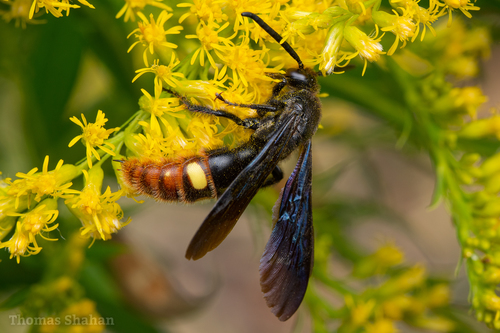


Blue-Winged Scoliid Wasp
scolia dubia
The Blue-Winged Scoliid Wasp, scientifically known as Scolia dubia, is a striking and highly beneficial insect found across North America. Often misunderstood due to its large size and metallic, almost intimidating wings, this wasp is actually a gentle solitary creature and a gardener's best ally. Rather than building aggressive colonial hives, the female lives a solitary lifestyle focused on seeking out the hidden grubs of scarab beetles. By controlling the populations of destructive pests like the Green June Beetle and the invasive Japanese Beetle, the Blue-Winged Scoliid Wasp plays a crucial role in maintaining healthy soil and plant ecosystems. Witnessing their graceful, low-hovering figure-eight flights over a summer lawn is a testament to nature's built-in pest control system.
Hábitat: Found in open meadows, pastures, gardens, and residential lawns where their host scarab beetle grubs are abundant beneath the soil.
This wasp measures roughly two centimeters in length and is easily identified by its unique, multi-colored body. The head, thorax, and first two abdominal segments are a sleek, jet black, while the lower half of the abdomen transitions into a rusty red or vibrant orange. Its most defining field mark is the presence of two distinct, bright yellow oval spots on the third abdominal segment. The wings are a stunning, iridescent dark blue or purplish-black that shimmer metallically in the sunlight, laying flat along its back when the insect is at rest.
Categoría
InsectosRareza
Common
Peligro
1/5 · Muy bajo
Snaps
¡Sé la primera persona en hacer un snap!
Because they heavily target the grubs of destructive scarab beetles, they are considered one of a gardener's most effective natural pest control agents.
Despite their menacing appearance and large size, male blue-winged scoliid wasps completely lack a stinger.
Females are remarkably docile and rarely sting humans unless they are stepped on or severely mishandled.
Scolia dubia larvae overwinter safely inside the underground soil burrows of their host grubs, spinning a silken cocoon before emerging as adults the following summer.
Females possess the remarkable ability to detect scarab beetle grubs hidden deep beneath the soil surface, likely using chemical or vibrational cues.
Using a highly specialized venom, the female wasp permanently paralyzes a beetle grub without killing it, ensuring a fresh food source for her hatching larva.
Males perform a distinct, low-altitude hovering flight in a figure-eight pattern over the ground to search for newly emerging females.
Adults feed entirely on floral nectar, while the larvae are obligate carnivorous parasitoids that consume beetle grubs.
Diferencias por edad: Larvae are entirely carnivorous parasitoids feeding on paralyzed beetle grubs, while mature adults transition to a herbivorous diet consisting only of floral nectar.
Cotinis nitida
The wasp larvae parasitize and consume the subterranean grubs of this species.
Popillia japonica
Considered an excellent natural biocontrol, the wasp utilizes the grubs of this invasive beetle as larval hosts.
Solidago canadensis
Adult wasps frequently visit these flowers to feed on nectar, aiding in pollination.
Aún no hay insignias de rasgos asignadas a este objeto.
Todavía no hay alias listados.
Las colecciones para este objeto aparecerán aquí a medida que se añadan más temas.
Peligro
1/5 · Muy bajo
Todavía no hay notas especiales de seguridad.
La forma más fácil de identificar a Blue-Winged Scoliid Wasp es usar la aplicación de identificación de naturaleza Snappit.
1-3 cm
2-4 cm
0.0001-0.0005 kg
1 años
15 km/h
Adults feed entirely on floral nectar, while the larvae are obligate carnivorous parasitoids that consume beetle grubs.
Found in open meadows, pastures, gardens, and residential lawns where their host scarab beetle grubs are abundant beneath the soil.
Acércate para separar los grupos y explorar dónde se ha fotografiado este objeto.
Los snaps recientes aparecerán aquí a medida que se añadan nuevas observaciones.










_sp._-_a_small_species_of_carpenter_bee_-_Flickr_-_S._Rae.jpg&width=800)





_(6974266104).jpg&width=800)
