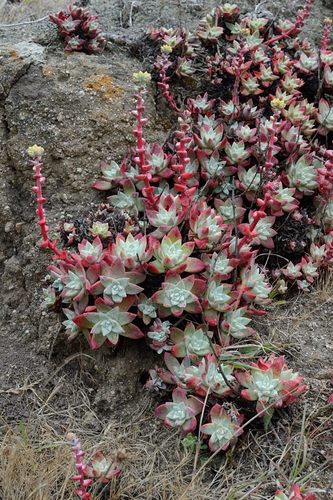


Bluff Lettuce
dudleya farinosa
Bluff Lettuce (Dudleya farinosa), also known as powdery liveforever, is a striking succulent plant native to the rocky, wave-swept cliffs of coastal Oregon and northern California. This resilient plant forms beautiful, compact rosettes of fleshy leaves that cling to sheer rock faces, braving salty ocean winds and intense coastal sun. Its common name 'liveforever' speaks to its incredible longevity and ability to survive in dry, harsh crevice environments. During the summer, Bluff Lettuce transforms its rugged look, sending up vibrant, red-tinted flowering stalks topped with clusters of bright yellow, star-shaped flowers. These blossoms provide vital nectar for native bees and hummingbirds. It plays an important role in coastal cliff ecology, stabilizing thin soils and adding a splash of color to the gray coastal rock.
Hábitat: Found clinging to steep, rocky sea cliffs, coastal bluffs, and rocky headlands directly exposed to ocean salt spray.
Bluff Lettuce is easily identified by its tight, basal rosettes of thick, wedge-shaped leaves, which typically measure 5 to 10 centimeters in diameter. The leaves are often covered in a heavy, powdery white epicuticular wax that helps prevent moisture loss, giving the plant a frosty, pale green or silvery-white appearance. In some individuals, the leaf tips turn a dramatic crimson red under intense sunlight. In summer, it produces erect, reddish-green flowering stalks reaching up to 35 centimeters tall, bearing dense cymes of pale to bright yellow, five-petaled flowers.
Categoría
PlantasRareza
Common
Peligro
1/5 · Muy bajo
Snaps
¡Sé la primera persona en hacer un snap!
In recent years, Bluff Lettuce has become the target of large-scale international plant smuggling rings, prompting conservationists and law enforcement to deploy high-tech surveillance on coastal cliffs.
The name Dudleya honors William Russell Dudley, the first head of the botany department at Stanford University.
The powdery white coating (farina) on the leaves can actually be wiped off by touch, leaving behind a fingerprint and making the plant more vulnerable to sunburn.
This resilient plant can absorb moisture directly from the heavy marine fog that regularly rolls in along the Pacific coast.
The thick, powdery white wax coating on its leaves acts as a natural sunscreen, reflecting intense solar radiation and minimizing moisture loss from coastal winds.
It possesses a strong, fibrous root system that penetrates deep into narrow rock crevices, anchoring the plant against heavy ocean winds and drawing up scarce moisture.
Like many desert succulents, it utilizes Crassulacean Acid Metabolism, opening its stomata at night to absorb carbon dioxide and reducing water loss during the day.
As a photosynthetic plant, Bluff Lettuce produces its own energy using sunlight, carbon dioxide, and water absorbed through its root system and coastal fog.
Bombus vosnesenskii
Visits the yellow flowers of Bluff Lettuce during the summer to feed on nectar, facilitating pollination.
Odocoileus hemionus
Sometimes browses on the fleshy leaves and flowering stalks of the succulent along coastal cliffs.
Euphydryas chalcedona
Caterpillars of this butterfly species occasionally feed on the leaves of Dudleya species.
Aún no hay insignias de rasgos asignadas a este objeto.
Todavía no hay alias listados.
Las colecciones para este objeto aparecerán aquí a medida que se añadan más temas.
Peligro
1/5 · Muy bajo
Todavía no hay notas especiales de seguridad.
La forma más fácil de identificar a Bluff Lettuce es usar la aplicación de identificación de naturaleza Snappit.
5+ cm
0.1+ kg
10+ años
As a photosynthetic plant, Bluff Lettuce produces its own energy using sunlight, carbon dioxide, and water absorbed through its root system and coastal fog.
Found clinging to steep, rocky sea cliffs, coastal bluffs, and rocky headlands directly exposed to ocean salt spray.
Photosynthesis
14+ días
Acércate para separar los grupos y explorar dónde se ha fotografiado este objeto.
Los snaps recientes aparecerán aquí a medida que se añadan nuevas observaciones.