

Boar Thistle
galactites tomentosus
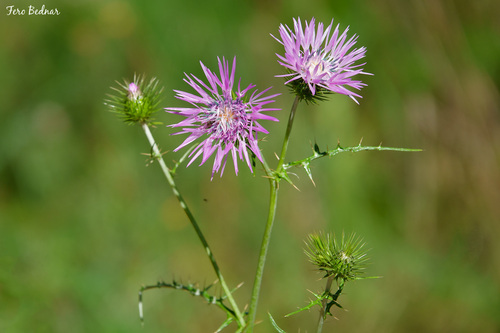
The Boar Thistle (Galactites tomentosus), also known as the purple milk thistle, is a striking herbaceous annual or biennial plant native to the Mediterranean basin. Belonging to the sunflower family (Asteraceae), this resilient species is easily recognized by its vibrant lilac-to-pink flower heads and highly ornamental, deeply lobed leaves decorated with bright white veins. It thrives in open, sunny environments, including dry pastures, roadsides, and abandoned fields, making it a familiar sight for walkers exploring Mediterranean landscapes. Historically, like many thistles, it holds ecological value as an essential food source for a variety of pollinators and seed-eating birds. Its scientific name, Galactites, derives from the Greek word for milk, highlighting the characteristic milky-white pattern on its spiny foliage. This combination of fierce, defensive thorns and delicate, fragrant blossoms makes it a fascinating subject for nature enthusiasts and a vital player in its native ecosystems.
Hábitat: Found in open, sun-drenched grasslands, pastures, disturbed soils, and along roadsides across the Mediterranean region.
This plant typically grows between 30 and 100 cm in height, characterized by its erect, woolly-white stems that are heavily branched. Its most striking feature is its variegated, deeply pinnatifid leaves, which are dark green with distinct, bright white veins on top and a soft, white felt-like texture underneath, tipped with sharp yellow spines. During its blooming season from spring to mid-summer, it produces dense, rounded flower heads measuring 2 to 3 cm across, containing numerous tubular florets that range in color from soft lilac and pink to pale purple.
Categoría
PlantasRareza
Common
Peligro
1/5 · Muy bajo
Snaps
¡Sé la primera persona en hacer un snap!
The genus name Galactites translates to 'milky' in Greek, a direct nod to the striking, milk-colored veins that web across its dark green leaves.
The plant is highly drought-tolerant, utilizing deep taproots and fuzzy white leaf undersides that reflect intense sunlight and prevent moisture loss.
While considered a noxious weed in some agricultural pastures due to its prickly defenses, it is a crucial ecological haven for beneficial native pollinators.
The striking white variegation on its leaves may serve to mimic leaf-miner damage, deterring insects and herbivores by making the plant appear less healthy.
Features sharp, rigid yellow spines along the leaf margins and surrounding the flower bases to deter large grazing mammals.
Its seeds are equipped with a feathery, hair-like pappus that allows them to drift on wind currents over long distances to colonize new ground.
As a photoautotrophic plant, the Boar Thistle synthesizes its own organic food from carbon dioxide and water using energy captured from sunlight.
Carduelis carduelis
The European Goldfinch feeds heavily on the high-energy seeds of the Boar Thistle during late summer.
Vanessa cardui
The Painted Lady butterfly uses this thistle species as a larval host plant, where caterpillars feed on the foliage.
Apis mellifera
Honey bees frequently visit the lilac flowers to collect nectar and pollen, acting as primary pollinators.
Aún no hay insignias de rasgos asignadas a este objeto.
Todavía no hay alias listados.
Las colecciones para este objeto aparecerán aquí a medida que se añadan más temas.
Peligro
1/5 · Muy bajo
Todavía no hay notas especiales de seguridad.
La forma más fácil de identificar a Boar Thistle es usar la aplicación de identificación de naturaleza Snappit.
30-100 cm
1-2 años
As a photoautotrophic plant, the Boar Thistle synthesizes its own organic food from carbon dioxide and water using energy captured from sunlight.
Found in open, sun-drenched grasslands, pastures, disturbed soils, and along roadsides across the Mediterranean region.
Acércate para separar los grupos y explorar dónde se ha fotografiado este objeto.
Los snaps recientes aparecerán aquí a medida que se añadan nuevas observaciones.