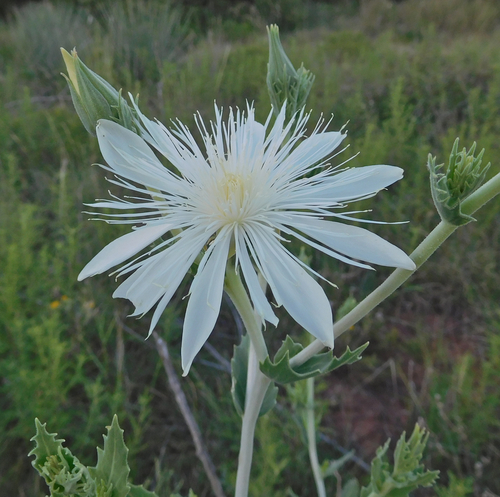


Bractless Blazingstar
mentzelia nuda
The Bractless Blazingstar (Mentzelia nuda) is a captivating herbaceous perennial native to the arid and semi-arid regions of North America. Renowned for its unique floral display, this plant stands out with its intricate, often showy flowers that primarily open during the evening or early morning, making it a distinct beauty of the desert night. Adaptable to harsh, dry conditions, it plays a vital role in its ecosystem by providing nectar for specialized pollinators and contributing to soil stabilization in challenging landscapes. Its presence signals a healthy, undisturbed native habitat, offering a glimpse into the resilient biodiversity of the American plains and intermountain west.
Hábitat: Found in dry, open habitats such as sandy plains, grasslands, roadsides, and rocky slopes across arid and semi-arid regions.
This blazingstar features erect, sturdy stems typically growing 30 to 100 centimeters tall, often branching in the upper half. Its leaves are generally lance-shaped, serrated, and covered in rough, short hairs, giving them a sandpaper-like texture. The star-shaped flowers are a brilliant yellow or creamy-white, composed of numerous narrow petals and a central cluster of bright yellow stamens, creating a luminous effect. The common name 'bractless' refers to the absence of leaf-like structures immediately beneath the flower, which is typical in many other plants.
Categoría
PlantasRareza
Common
Peligro
1/5 · Muy bajo
Snaps
¡Sé la primera persona en hacer un snap!
Bractless Blazingstar flowers possess a unique iridescent quality, appearing to shimmer in moonlight, which is thought to aid in attracting nocturnal pollinators.
Despite its preference for dry, often inhospitable environments, this plant can be surprisingly delicate in appearance, contrasting with its hardy nature.
Indigenous cultures have historically utilized parts of Mentzelia nuda for traditional medicinal purposes, including poultices for various ailments.
The plant's scientific name 'nuda' means 'naked' or 'bractless', referring to the absence of small leaves (bracts) subtending its flowers.
The flowers of the Bractless Blazingstar predominantly open at dusk and remain open through the night, closing by late morning. This strategy is adapted to attract nocturnal pollinators like sphinx moths.
It develops a robust, deep taproot that allows it to access deeper soil moisture. This adaptation is crucial for its survival and flourishing in extremely arid and nutrient-poor environments.
Its seeds are often covered in small, barbed hairs or a sticky substance, enabling them to cling to the fur or feathers of passing animals. This facilitates efficient dispersal across wide distances, promoting genetic diversity and colonization of new areas.
As a photosynthetic plant, the Bractless Blazingstar produces its own food by converting sunlight, water, and carbon dioxide into sugars. It absorbs essential minerals and water from the soil through its roots.
Hyles lineata
Primary nocturnal pollinator, crucial for reproduction.
Antilocapra americana
Provides forage, particularly young shoots and leaves, for grazing herbivores.
Various species
Forms symbiotic relationships with fungi to enhance nutrient and water uptake from soil.
Various Rodentia
Seeds with sticky coatings adhere to animal fur, aiding in long-distance dispersal.
Aún no hay insignias de rasgos asignadas a este objeto.
Todavía no hay alias listados.
Las colecciones para este objeto aparecerán aquí a medida que se añadan más temas.
Peligro
1/5 · Muy bajo
Todavía no hay notas especiales de seguridad.
La forma más fácil de identificar a Bractless Blazingstar es usar la aplicación de identificación de naturaleza Snappit.
30-100 cm
0.1-0.5 kg
1-3 años
As a photosynthetic plant, the Bractless Blazingstar produces its own food by converting sunlight, water, and carbon dioxide into sugars. It absorbs essential minerals and water from the soil through its roots.
Found in dry, open habitats such as sandy plains, grasslands, roadsides, and rocky slopes across arid and semi-arid regions.
Photosynthesis/nutrient Absorption
Acércate para separar los grupos y explorar dónde se ha fotografiado este objeto.
Los snaps recientes aparecerán aquí a medida que se añadan nuevas observaciones.