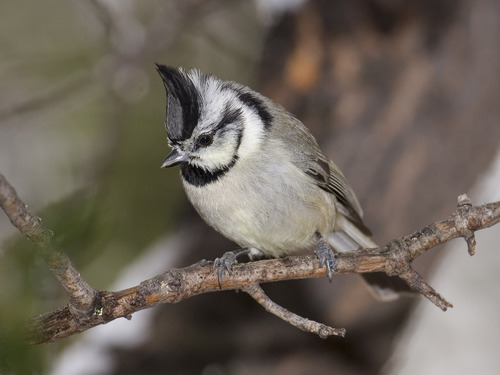


Bridled Titmouse
baeolophus wollweberi
The Bridled Titmouse is a charismatic, small songbird native to the oak-pine woodlands of the southwestern United States and Mexico. Known for its hyperactive energy and striking facial markings, this species is a beloved find for birdwatchers exploring montane canyons. Unlike most other titmice, which tend to be more solitary or pair-centric during the breeding season, the Bridled Titmouse is highly social. They frequently form cooperative breeding groups to raise young, and in the winter, they act as the energetic anchors for mixed-species foraging flocks. Their bright, curious disposition and acrobatic antics in the canopy make them both an ecological cornerstone of their habitat and a joy to observe in the wild.
Hábitat: Found in oak-pine woodlands and dry riparian canyons, typically at mid-to-high elevations.
This small, crested songbird is easily recognized by its bold, black-and-white 'bridled' face pattern, featuring sharp black lines framing a white cheek and wrapping around the eye like a harness. It sports a prominent, pointed gray crest, a gray back, and pale, light gray-to-white underparts. Measuring roughly 11 to 13 centimeters in length with a wingspan of about 18 to 21 centimeters, its short, stout bill is perfectly adapted for cracking seeds and snatching insects from the underside of leaves.
Categoría
AvesRareza
Common
Peligro
1/5 · Muy bajo
Snaps
¡Sé la primera persona en hacer un snap!
They are considered a 'nucleus species' in their native range, meaning other migratory songbirds rely on them to find food and safety in winter.
They are known to line their cup-shaped nests with soft materials, including animal fur and even shed snake skin, to keep their eggs warm.
Unlike most other chickadees and titmice, the Bridled Titmouse maintains its striking, complex facial markings year-round without seasonal fading.
They act as the sentinel leaders of mixed-species foraging flocks, alerting other bird species to nearby predators with distinct, buzzy alarm calls.
Equipped with strong feet, they can hang completely upside down from the tips of pine cones and twigs to access hidden insects and seeds.
Unusually for North American parids, they often breed cooperatively, utilizing helpers from previous clutches to defend the nest and feed new chicks.
Feeds heavily on insects and spiders during the warm breeding months, transitioning to acorns, pine seeds, and small berries during winter.
Diferencias por edad: Nestlings are fed an exclusive diet of high-protein insects and larvae, whereas adults consume a variety of seeds and berries during the cold season.
Quercus arizonica
Frequently nests in natural cavities or old woodpecker holes within this mature oak tree species.
Corthylio calendula
Forms mixed-species winter foraging flocks where they compete for and share insect resources.
Accipiter cooperii
A common avian predator that hunts small songbirds like the Bridled Titmouse in wooded habitats.
Aún no hay insignias de rasgos asignadas a este objeto.
Todavía no hay alias listados.
Las colecciones para este objeto aparecerán aquí a medida que se añadan más temas.
Peligro
1/5 · Muy bajo
Todavía no hay notas especiales de seguridad.
La forma más fácil de identificar a Bridled Titmouse es usar la aplicación de identificación de naturaleza Snappit.
11+ cm
18+ cm
0.008+ kg
2+ años
25 km/h
Feeds heavily on insects and spiders during the warm breeding months, transitioning to acorns, pine seeds, and small berries during winter.
Found in oak-pine woodlands and dry riparian canyons, typically at mid-to-high elevations.
Acércate para separar los grupos y explorar dónde se ha fotografiado este objeto.
Los snaps recientes aparecerán aquí a medida que se añadan nuevas observaciones.













