
.jpg&width=800)





broad-leaved sweet pea
Lathyrus latifolius
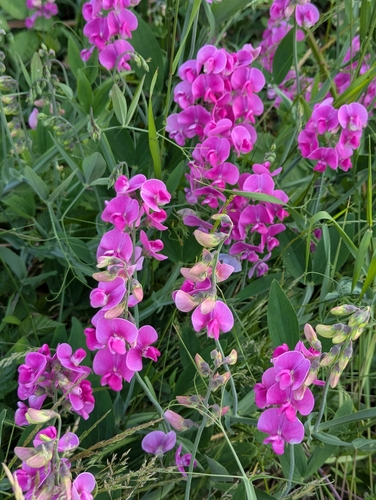
The broad-leaved sweet pea is a lovely flower that grows in many gardens. It has big, green leaves and colorful flowers that can be pink, purple, or white. These flowers smell sweet and attract butterflies!
Hábitat: Urban areas
The broad-leaved sweet pea has vibrant clusters of pink, purple, or white flowers on long, winged stems. Its most distinctive feature is its pairs of wide, flattened leaves, which give the plant its name. These features help it climb and sprawl gracefully.
Categoría
PlantasRareza
Common
Peligro
1/5 · Muy bajo
Snaps
¡Sé la primera persona en hacer un snap!
Even though it's called 'sweet pea,' its seeds are not for eating and should be avoided!
Its scientific name, Lathyrus latifolius, means 'broad-leaved vetchling' in Latin!
This tough perennial can live for many years, often growing back bigger and stronger each spring!
Unlike many sweet peas, the broad-leaved variety has little to no fragrance, letting its vibrant colors shine!
Broad-leaved sweet pea can grow strong tendrils that wrap around supports, helping it climb high to reach more sunlight.
This plant has special bacteria in its roots that help it enrich the soil with important nutrients, aiding its own growth.
Broad-leaved sweet pea can grow deep, tough roots, helping it survive dry spells and grow back year after year.
Bombus terrestris
Visits flowers for nectar and pollen
Apis mellifera
Feeds on flower nectar and pollen
Rhizobium leguminosarum
Lives in roots, fixes nitrogen for plant
Deroceras reticulatum
May feed on leaves and young shoots
Las plantas caducifolias pierden periódicamente todas sus hojas, por lo general durante el otoño o las estaciones secas.
Las plantas con flores son cualquier planta que produce flores como parte de su ciclo reproductivo.
Las plantas de floración de verano producen sus flores durante la temporada estival, a menudo aportando un color vibrante cuando muchas otras plantas ya han terminado de florecer.
Las flores fragantes emiten un aroma agradable, a menudo para atraer polinizadores o como defensa.

Las plantas siempre en flor producen flores de forma continua o en repetidas floraciones durante un largo período.

Colorido describe a organismos u objetos que exhiben una amplia variedad de colores brillantes y distintivos.

Describe plantas que son particularmente atractivas y beneficiosas para una amplia variedad de organismos polinizadores.

Esta característica de hábitat indica especies que pueden coexistir con los humanos en entornos urbanos y suburbanos, utilizando estructuras artificiales y espacios verdes.
Todavía no hay alias listados.
Peligro
1/5 · Muy bajo
Always check with an adult before touching or picking flowers.
150-300 cm
60-180 cm
2-4 cm
Verano
No
Leve
Perenne
Insectos
Acércate para separar los grupos y explorar dónde se ha fotografiado este objeto.
Los snaps recientes aparecerán aquí a medida que se añadan nuevas observaciones.

Ohio, US
Puedes ver Petirrojo Americano, Ciervo De Cola Blanca y Halcón Peregrino.
Ver guía →

Washington, US
Puedes ver Bigleaf Maple, Common Snowberry y Osoberry.
Ver guía →
Washington, US
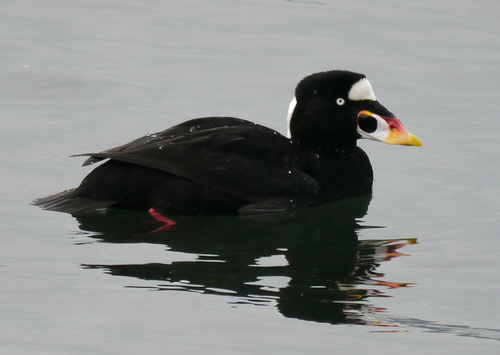
Puedes ver Surf Scoter, Eastern Cottontail y Rosa Silvestre.
Ver guía →
Michigan, US
Puedes ver Broad-Leaved Sweet Pea, Garlic Mustard y White Baneberry.
Ver guía →

Washington, US
Puedes ver Purple Foxglove, Tansy y Broad-Leaved Sweet Pea.
Ver guía →

British Columbia, CA
Puedes ver Ochre Sea Star y Yellow Shore Crab.
Ver guía →












