

Brown-Eyed Susan
rudbeckia triloba
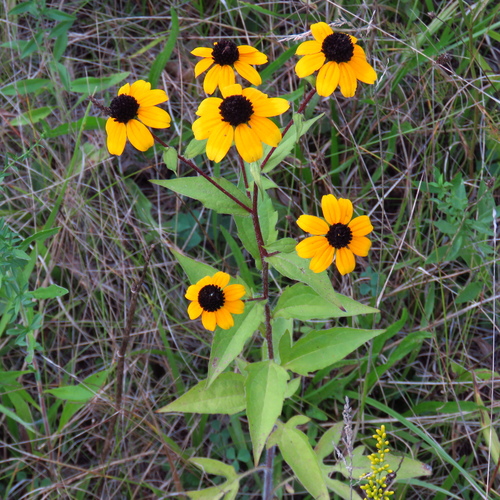
The Brown-Eyed Susan (Rudbeckia triloba), also commonly known as the thin-leaved coneflower, is a cheerful and robust wildflower native to the central and eastern regions of North America. Renowned for its prolific blooming habits, this plant brings an explosion of warm, golden color to late summer landscapes, prairies, and open woodlands. While it is closely related to the well-known Black-Eyed Susan, the Brown-Eyed Susan is distinguished by its bushier growth habit and smaller, much more numerous daisy-like flower heads. Ecologically, this species is highly valuable. Its late-season blossoms provide a vital nectar source for a vast array of native bees, butterflies, and beneficial insects when other food sources begin to dwindle. Additionally, its dried seed heads serve as an essential winter food resource for songbirds, making it a beloved choice for conservation-minded gardeners and natural restoration projects alike.
Hábitat: Typically found in moist to dry prairies, open woodlands, savannas, limestone glades, and along roadsides or disturbed areas.
Rudbeckia triloba is a multi-branched, bushy wildflower that typically stands between 60 and 150 cm tall. It features numerous small flower heads, each measuring 2 to 5 cm across, consisting of 8 to 15 bright yellow-to-orange ray florets surrounding a prominent, dome-shaped, dark purple-brown central disk. A key identifier is its leaves: the lower leaves are divided into three distinct lobes (hence the name 'triloba'), while the upper leaves are simple, narrow, and roughly textured with fine, stiff hairs along the stems and foliage.
Categoría
PlantasRareza
Common
Peligro
1/5 · Muy bajo
Snaps
¡Sé la primera persona en hacer un snap!
The specific name 'triloba' directly references the unique three-lobed shape of the lower leaves on the plant's stem.
Though technically a short-lived perennial or biennial, it easily maintains its presence in gardens for decades by readily self-seeding every autumn.
Unlike typical Black-Eyed Susans, which have large individual flower heads, a single mature Brown-Eyed Susan plant can produce hundreds of smaller blossoms simultaneously, creating a mist of gold.
Its lower leaves are divided into three lobes to maximize sunlight interception in partially shaded woodland borders while minimizing wind resistance.
A single plant can produce thousands of seeds that are easily dispersed by wind and wildlife, allowing it to rapidly colonize disturbed soils.
It possesses a deep, fibrous root system that allows the plant to tolerate dry summer conditions and nutrient-poor soils once established.
As a photosynthetic plant, the Brown-Eyed Susan synthesizes its own organic compounds using solar energy, carbon dioxide, water, and essential mineral nutrients absorbed through its root system.
Chlosyne nycteis
The caterpillars of this butterfly feed on the leaves of the plant as their primary larval host.
Spinus tristis
Goldfinches feed on the high-fat seeds from the dried flower cones during the late autumn and winter months.
Bombus impatiens
Bumble bees frequently visit the flowers for nectar and pollen, acting as key pollinators.
Aún no hay insignias de rasgos asignadas a este objeto.
Todavía no hay alias listados.
Las colecciones para este objeto aparecerán aquí a medida que se añadan más temas.
Peligro
1/5 · Muy bajo
Todavía no hay notas especiales de seguridad.
La forma más fácil de identificar a Brown-Eyed Susan es usar la aplicación de identificación de naturaleza Snappit.
60-150 cm
2-3 años
As a photosynthetic plant, the Brown-Eyed Susan synthesizes its own organic compounds using solar energy, carbon dioxide, water, and essential mineral nutrients absorbed through its root system.
Typically found in moist to dry prairies, open woodlands, savannas, limestone glades, and along roadsides or disturbed areas.
Acércate para separar los grupos y explorar dónde se ha fotografiado este objeto.
Los snaps recientes aparecerán aquí a medida que se añadan nuevas observaciones.













