

Buffalo-Nut
pyrularia pubera
The Buffalo-Nut (Pyrularia pubera) is a fascinating deciduous shrub native to the eastern United States, primarily known for its hemiparasitic nature. Unlike full parasites, it produces its own chlorophyll and can photosynthesize, but it also taps into the root systems of nearby host plants to extract water and mineral nutrients. This unique feeding strategy allows it to thrive in diverse woodland environments. Its distinctive fruit, a small, yellowish-green drupe resembling a miniature pear or buffalo head, gives the plant its common name and adds to its intrigue, despite being toxic to humans if ingested. Beyond its parasitic lifestyle, the Buffalo-Nut plays a subtle but integral role in its ecosystem. Its unique chemistry, particularly the presence of pyrularin in its fruits, influences its interactions with wildlife, making it a plant of considerable ecological interest. It stands as a testament to the diverse and complex strategies plants employ for survival and resource acquisition.
Hábitat: Buffalo-Nut is typically found in rich, undisturbed deciduous or mixed woodlands, moist cove forests, and along shaded stream banks, often on well-drained slopes in mountainous regions.
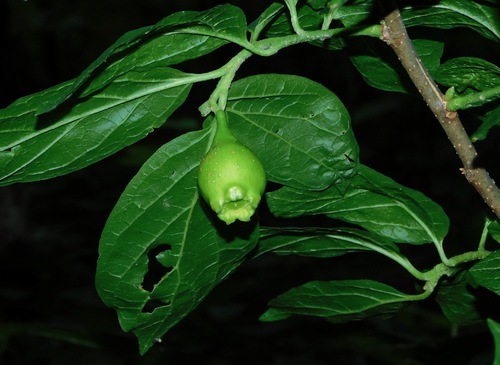
Buffalo-Nut is a medium-sized deciduous shrub typically growing 1 to 4 meters tall, often forming dense thickets. Its leaves are alternate, elliptical to oval, bright green, and smooth, with entire margins. In late spring to early summer, it produces small, inconspicuous yellowish-green flowers arranged in terminal or axillary racemes. The most striking visual identifier is its fruit, a globular to pear-shaped drupe, about 2-3 cm long, that ripens from green to a yellowish-green or greenish-orange in late summer and fall. The bark is relatively smooth and grayish-brown.
Categoría
PlantasRareza
Common
Peligro
1/5 · Muy bajo
Snaps
¡Sé la primera persona en hacer un snap!
Despite its toxicity to humans, the fruits of the Buffalo-Nut are reportedly consumed by some wildlife, notably Wild Turkeys, which seem to tolerate the pyrularin.
Historically, indigenous peoples used the oil extracted from the fruit of Pyrularia pubera for various medicinal purposes, including as a liniment for joint pain.
Its hemiparasitic nature means that while it steals resources, it still contributes to the forest's primary productivity through its own photosynthesis, making it less dependent than full parasites.
The 'nut' in Buffalo-Nut is actually a drupe, a fleshy fruit with a hard pit inside, similar to a peach or cherry.
This plant has haustoria that tap into the root systems of a wide variety of woody host plants, drawing water and nutrients while still photosynthesizing its own food. This allows it to access resources more efficiently in competitive environments.
All parts of the plant, especially the fruit, contain pyrularin, a toxic fatty acid. This chemical deters most herbivores from consuming large quantities, protecting the plant from excessive browsing.
Through its parasitic connections, the Buffalo-Nut develops an extensive and robust root system linked to multiple hosts. This network enhances its stability and access to resources, contributing to its long-term survival in forest understories.
The Buffalo-Nut obtains much of its water and mineral nutrients by attaching its roots to the root systems of other woody plants. While it can photosynthesize, this parasitic relationship provides a significant supplement to its nutritional needs.
Quercus alba
Provides water and nutrients to the Buffalo-Nut.
Carya tomentosa
Provides water and nutrients to the Buffalo-Nut.
Meleagris gallopavo
Consumes the fruit and disperses seeds.
Lucilia sericata
Pollinates the flowers, facilitating reproduction.
Aún no hay insignias de rasgos asignadas a este objeto.
Todavía no hay alias listados.
Las colecciones para este objeto aparecerán aquí a medida que se añadan más temas.
Peligro
1/5 · Muy bajo
Todavía no hay notas especiales de seguridad.
La forma más fácil de identificar a Buffalo-Nut es usar la aplicación de identificación de naturaleza Snappit.
100-400 cm
15-30 años
The Buffalo-Nut obtains much of its water and mineral nutrients by attaching its roots to the root systems of other woody plants. While it can photosynthesize, this parasitic relationship provides a significant supplement to its nutritional needs.
Buffalo-Nut is typically found in rich, undisturbed deciduous or mixed woodlands, moist cove forests, and along shaded stream banks, often on well-drained slopes in mountainous regions.
Root Attachment/parasitism
Acércate para separar los grupos y explorar dónde se ha fotografiado este objeto.
Los snaps recientes aparecerán aquí a medida que se añadan nuevas observaciones.















