

Buttonweed
diodia virginiana
Virginia Buttonweed (Diodia virginiana) is a resilient, spreading perennial herb native to the wetlands and moist areas of the Americas. While it is often considered an aggressive and difficult-to-control weed in manicured turfgrass and golf courses, it plays a natural role in pioneer wetland ecology. This species thrives in damp, poorly drained soils where other plants struggle, forming dense mats that help stabilize muddy soils. Its ability to tolerate wet conditions and survive heavy mowing makes it exceptionally hardy. What makes Buttonweed fascinating is its dual-method survival strategy. It reproduces effectively both through seed dispersal and vegetative cloning. Its seeds are enclosed in thick, buoyant seed pods that float on water, while its sprawling stems easily take root at the nodes. This allows it to quickly conquer wet ditches, marshes, and over-watered lawns, making it a true master of moist disturbed ground.
Hábitat: Found in wet lawns, moist pastures, roadside ditches, and wetland margins.
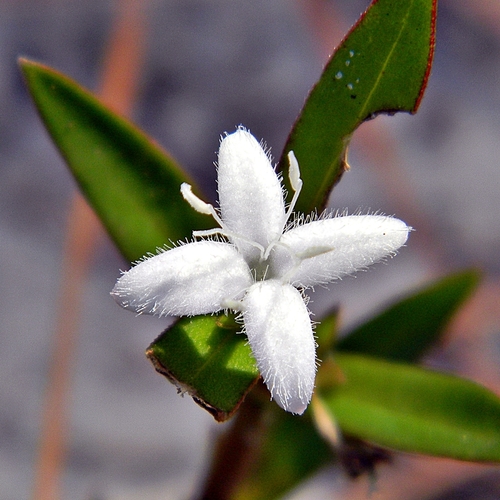
This low-growing, mat-forming plant features sprawling, slightly hairy green-to-purplish stems that can grow up to 60 cm long. Its leaves are oppositely arranged, lance-shaped, and often present a distinctive yellow-mottled or chlorotic appearance due to a common systemic virus. During the summer, tiny, white, star-shaped flowers emerge from the leaf axils. Each flower is about 8 to 10 mm wide with four petals that are hairy on the inside. The resulting fruit is a green, ribbed, egg-shaped capsule resembling a small button, which gives the plant its common name.
Categoría
PlantasRareza
Common
Peligro
1/5 · Muy bajo
Snaps
¡Sé la primera persona en hacer un snap!
Its leaves frequently showcase a striking yellow mosaic pattern, which is actually the result of an infection by the Tobacco Ringspot Virus.
The green, ribbed fruit resembles a miniature button, giving this resilient weed its charming common name.
Virginia buttonweed is exceptionally difficult to weed because even a tiny severed root fragment left in the soil can grow into a completely new plant.
Stems can root dynamically at their nodes whenever they touch moist soil, allowing the plant to clone itself rapidly.
The seed-bearing fruit is spongy and contains air pockets, allowing it to float on rainwater and spread to new areas via drainage.
Due to its prostrate growth habit, it can adapt to grow extremely flat to the ground, easily escaping lawnmower blades.
As a photoautotrophic plant, it produces energy through photosynthesis by capturing sunlight and absorbing water and minerals from the soil.
Tobacco ringspot virus
Hosts the virus that causes the characteristic yellow mottling on its leaves.
Apis mellifera
Visits the small white flowers to collect nectar, acting as a minor pollinator.
Cynodon dactylon
Competes aggressively with turfgrasses for space, light, and nutrients in lawns.
Aún no hay insignias de rasgos asignadas a este objeto.
Todavía no hay alias listados.
Las colecciones para este objeto aparecerán aquí a medida que se añadan más temas.
Peligro
1/5 · Muy bajo
Todavía no hay notas especiales de seguridad.
La forma más fácil de identificar a Buttonweed es usar la aplicación de identificación de naturaleza Snappit.
10+ cm
0.01+ kg
1+ años
As a photoautotrophic plant, it produces energy through photosynthesis by capturing sunlight and absorbing water and minerals from the soil.
Found in wet lawns, moist pastures, roadside ditches, and wetland margins.
Acércate para separar los grupos y explorar dónde se ha fotografiado este objeto.
Los snaps recientes aparecerán aquí a medida que se añadan nuevas observaciones.