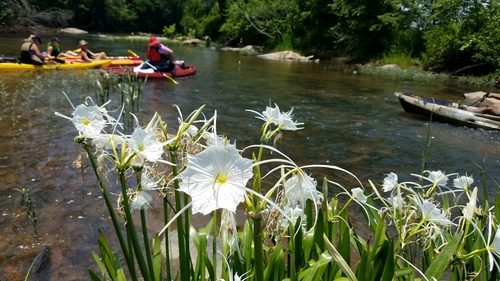


Cahaba Lily
hymenocallis coronaria
The Cahaba Lily (Hymenocallis coronaria) is a majestic, aquatic wildflower famous for its striking white blooms and highly specialized habitat requirements. Found only in the swift-flowing, rocky shoals of rivers and streams in the southeastern United States, this elegant member of the Amaryllis family is a true botanical treasure. Its large, fragrant flowers open for just one day, creating a brief but spectacular seasonal showcase that draws nature enthusiasts from all over the world.
Hábitat: Found exclusively in swift-flowing, shallow currents of clean rivers and streams, anchored in rocky shoals that receive full sunlight.
This stunning perennial features large, white flowers up to 15 centimeters wide, characterized by a distinct central cup (corona) resembling a daffodil, from which six long, spider-like petals extend. The flowers arise in clusters on top of a stout, leafless stalk that reaches heights of 60 to 90 centimeters, arising from a clump of strap-like, dark green leaves.
Categoría
PlantasRareza
Common
Peligro
1/5 · Muy bajo
Snaps
¡Sé la primera persona en hacer un snap!
Each individual flower of the Cahaba Lily blooms for only a single day, opening at dusk and withering by the following afternoon.
The city of West Blocton, Alabama, hosts an annual Cahaba Lily Festival every May to celebrate and raise conservation awareness for this rare botanical wonder.
The plant's seeds are completely self-contained with their own water supply, allowing them to germinate almost immediately upon sinking.
Possesses incredibly strong, heavy bulbs that wedge deep into the crevices of rocky river shoals to resist being swept away by strong aquatic currents.
Produces large, dense, bulb-like green seeds that sink immediately to the riverbed, preventing them from floating away and helping them lodge securely in rocky cracks.
Opens its flowers at dusk, emitting a strong fragrance to attract night-flying pollinators, maximizing pollination efficiency during its single-day lifespan.
The Cahaba Lily produces its own energy via photosynthesis, utilizing sunlight, carbon dioxide, water, and minerals absorbed through its roots in the riverbed.
Paratrea plebeja
Pollinated primarily at night by this large moth species attracted to its sweet fragrance.
Odocoileus virginianus
Occasionally grazes on the exposed green leaves and flower buds when river levels are low.
Aún no hay insignias de rasgos asignadas a este objeto.
Todavía no hay alias listados.
Las colecciones para este objeto aparecerán aquí a medida que se añadan más temas.
Peligro
1/5 · Muy bajo
Todavía no hay notas especiales de seguridad.
La forma más fácil de identificar a Cahaba Lily es usar la aplicación de identificación de naturaleza Snappit.
60-90 cm
5-20 años
The Cahaba Lily produces its own energy via photosynthesis, utilizing sunlight, carbon dioxide, water, and minerals absorbed through its roots in the riverbed.
Found exclusively in swift-flowing, shallow currents of clean rivers and streams, anchored in rocky shoals that receive full sunlight.
Photosynthesis
Acércate para separar los grupos y explorar dónde se ha fotografiado este objeto.
Los snaps recientes aparecerán aquí a medida que se añadan nuevas observaciones.
















