

California Aglaja
navanax inermis
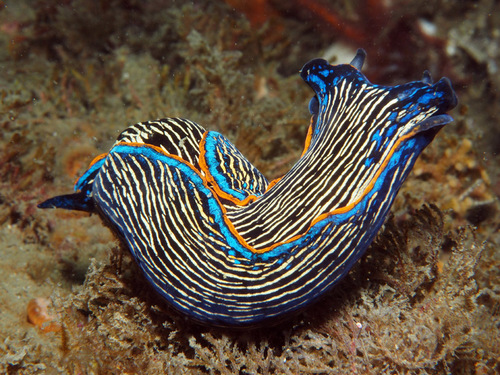
The California Aglaja (Navanax inermis), commonly known as the Navanax, is a striking predatory sea slug native to the eastern Pacific coast. Although it looks similar to a nudibranch, it belongs to the Cephalaspidea order, or headshield slugs. This voracious carnivore is a master hunter of the intertidal zone, navigating muddy estuaries, sandy bays, and rocky tide pools. Unlike passive grazers, the Navanax actively tracks down prey by detecting chemical signals in their slime trails. It is famous among marine biologists for its colorful, velvet-like body and its dramatic, vacuum-like feeding method, where it rapidly engulfs its target whole.
Hábitat: Typically found in muddy estuaries, sandy bays, eelgrass beds, and rocky intertidal tide pools along the Pacific coast.
The California Aglaja features an elongated, cylindrical body that can grow up to 22 centimeters in length. Its base color ranges from deep dark brown to velvety black, beautifully ornamented with bright yellow or orange longitudinal stripes and brilliant metallic blue spots along its parapodia. It lacks an external shell, instead possessing an internal, reduced shell plate hidden within its mantle. The head is flattened into a characteristic shield shape used for burrowing, and it lacks the highly visible nudibranch rhinophores, relying instead on sensitive chemical-receptive bristles near its mouth.
Categoría
InvertebrateRareza
Common
Peligro
1/5 · Muy bajo
Snaps
¡Sé la primera persona en hacer un snap!
Despite having eyes, the California Aglaja is essentially blind and relies almost entirely on its highly developed sense of touch and chemoreception to navigate and hunt.
It is a simultaneous hermaphrodite, meaning a single individual possesses both male and female reproductive organs and can occasionally form mating chains with multiple individuals.
Its feeding mechanism is so fast and powerful that it acts like a biological vacuum cleaner, sucking in prey before they can react.
When digesting bubble snails, it dissolves the soft body of the snail inside its gut and later regurgitates the completely intact, empty shell.
Detects and follows the mucus trails of other gastropods using specialized chemical receptors on its front sensory bristles.
Employs a highly muscular, toothless pharynx to generate a powerful suction that rapidly sucks prey whole into its mouth.
Expels a thick, yellow-to-red toxic ink from its mantle cavity when threatened to deter predators like crabs and fish.
A voracious predator that feeds primarily on other sea slugs, bubble snails, and nudibranchs, often swallowing them entirely whole.
Diferencias por edad: Juveniles feed on tiny gastropods and small bubble snails, transitioning to larger sea slugs and cannibalism as they mature.
Bulla gouldiana
The California Aglaja actively hunts and consumes this common bubble snail, swallowing it whole.
Navanax inermis
Larger individuals regularly hunt and cannibalize smaller members of their own species.
Hermissenda crassicornis
Navanax will track and prey upon this colorful nudibranch despite its stinging nematocysts.
Aún no hay insignias de rasgos asignadas a este objeto.
Todavía no hay alias listados.
Las colecciones para este objeto aparecerán aquí a medida que se añadan más temas.
Peligro
1/5 · Muy bajo
Todavía no hay notas especiales de seguridad.
La forma más fácil de identificar a California Aglaja es usar la aplicación de identificación de naturaleza Snappit.
5-22 cm
0.05-0.35 kg
1-2 años
A voracious predator that feeds primarily on other sea slugs, bubble snails, and nudibranchs, often swallowing them entirely whole.
Typically found in muddy estuaries, sandy bays, eelgrass beds, and rocky intertidal tide pools along the Pacific coast.
Pursuit
10000-80000
Acércate para separar los grupos y explorar dónde se ha fotografiado este objeto.
Los snaps recientes aparecerán aquí a medida que se añadan nuevas observaciones.





.jpg&width=800)




.jpg&width=800)






