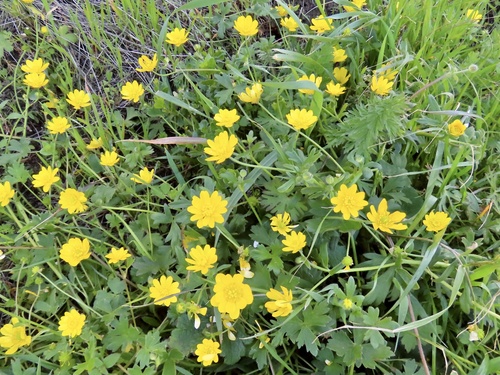


California Buttercup
ranunculus californicus
The California Buttercup is a vibrant, sun-loving perennial herb native to the Pacific Coast of North America. Renowned for its brilliant yellow blooms, this resilient plant is one of the first wild flowers to carpet the hillsides and meadows in late winter and early spring, signaling the end of the cold season. Its cheerful presence is highly valued in native plant gardens and ecological restoration efforts across its native range.
Hábitat: Typically found in moist grasslands, open oak woodlands, chaparral, and coastal sage scrub communities of California and Oregon.
This plant typically grows between 15 to 70 centimeters tall on slender, upright stems. It features bright, glossy yellow flowers with 9 to 17 petals, which is significantly more than most other buttercup species. The petals have a highly reflective, almost varnished texture that gleams under direct sunlight. The leaves are deeply lobed, hairy, and arranged in a basal rosette, with smaller, simpler leaves appearing higher up the stems.
Categoría
PlantasRareza
Common
Peligro
1/5 · Muy bajo
Snaps
¡Sé la primera persona en hacer un snap!
Indigenous peoples, such as the Miwok, historically used the seeds of the California buttercup to make a traditional food called pinole.
The petals have a unique microscopic structure with a layer of starch that reflects light like a mirror, giving them an exceptionally glossy, varnished appearance.
The plant contains protoanemonin, a bitter toxin that protects it from being eaten by livestock and deer, though it loses its toxicity when dried.
A microscopic starch layer within the petals reflects light like a mirror, enhancing visibility to early-season pollinators.
Produces protoanemonin, a bitter-tasting toxin that deters grazing by mammalian herbivores.
The flowers slightly track the sun, warming their reproductive organs to increase pollen viability and attract insects.
This plant is an autotroph that generates its own energy from sunlight, carbon dioxide, and water through photosynthesis.
Apis mellifera
Provides nectar and pollen, receiving pollination services in return.
Bombus vosnesenskii
Feeds on the nectar and pollen of the buttercup, assisting with pollination.
Thomomys bottae
Feeds on the underground roots and corms of the plant.
Aún no hay insignias de rasgos asignadas a este objeto.
Todavía no hay alias listados.
Las colecciones para este objeto aparecerán aquí a medida que se añadan más temas.
Peligro
1/5 · Muy bajo
Todavía no hay notas especiales de seguridad.
La forma más fácil de identificar a California Buttercup es usar la aplicación de identificación de naturaleza Snappit.
15-70 cm
2-10 años
This plant is an autotroph that generates its own energy from sunlight, carbon dioxide, and water through photosynthesis.
Typically found in moist grasslands, open oak woodlands, chaparral, and coastal sage scrub communities of California and Oregon.
Acércate para separar los grupos y explorar dónde se ha fotografiado este objeto.
Los snaps recientes aparecerán aquí a medida que se añadan nuevas observaciones.












.jpg&width=800)