

California Goldfields
lasthenia californica
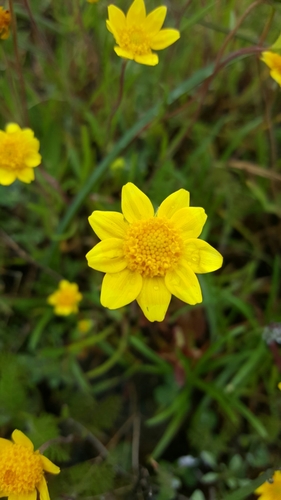
California Goldfields (Lasthenia californica) is a cheerful, low-growing annual wildflower native to the open grasslands, coastal bluffs, and vernal pool margins of western North America. During early spring, these resilient plants carpet entire hillsides and valleys in a dazzling blanket of bright, golden-yellow blooms. This spectacular display is not only a visual marvel but also a vital ecological event, signaling the peak of spring and drawing in a multitude of native pollinators. Extremely adaptable, the species often thrives in poor, clay-heavy, or serpentine soils where other plants struggle. Its rapid life cycle allows it to germinate, bloom, set seed, and die back before the harsh, dry summer heat sets in, making it a master of drought avoidance.
Hábitat: Found in open, sunny habitats including grasslands, oak woodlands, coastal scrub, vernal pools, and areas with clay or serpentine soils.
California Goldfields are small, slender annual herbs growing up to 10 to 40 cm tall. They feature hairy, reddish-green stems holding narrow, opposite linear leaves that are sometimes deeply lobed. The plant is topped by small, daisy-like flower heads, roughly 1 to 2 cm in diameter, composed of both bright yellow ray florets and matching yellow central disk florets. Each flower head is cradled by a cup of green bracts. When growing in mass, they create dense, vibrant yellow carpets that are easily recognizable from a distance.
Categoría
PlantasRareza
Common
Peligro
1/5 · Muy bajo
Snaps
¡Sé la primera persona en hacer un snap!
During massive spring 'superblooms', California Goldfields can grow so densely that their bright yellow sheets of color are visible from orbiting satellites.
Indigenous Californian peoples, such as the Miwok, historically harvested the tiny, abundant seeds of this plant to grind into a nutritious food meal called pinole.
The genus name Lasthenia is named after Lasthenia of Mantinea, an ancient Greek woman who dressed as a man in order to study philosophy under Plato.
Able to thrive in harsh serpentine soils high in heavy metals and low in essential nutrients where competing plants cannot survive.
Completes its entire life cycle rapidly during the damp spring months, setting hardy seeds before the dry summer drought begins.
Flowers feature ultraviolet patterns invisible to humans but highly visible to bees, directing pollinators straight to the nectar.
As a photosynthetic plant, California Goldfields produces its own food using sunlight, carbon dioxide, water, and soil nutrients.
Euphydryas editha bayensis
Adult butterflies rely heavily on the nectar of California Goldfields as a primary energy source during their spring flight season.
Andrena
Solitary mining bees forage heavily on the pollen and nectar, acting as highly effective pollinators.
Aún no hay insignias de rasgos asignadas a este objeto.
Todavía no hay alias listados.
Las colecciones para este objeto aparecerán aquí a medida que se añadan más temas.
Peligro
1/5 · Muy bajo
Todavía no hay notas especiales de seguridad.
La forma más fácil de identificar a California Goldfields es usar la aplicación de identificación de naturaleza Snappit.
10-40 cm
0-1 años
As a photosynthetic plant, California Goldfields produces its own food using sunlight, carbon dioxide, water, and soil nutrients.
Found in open, sunny habitats including grasslands, oak woodlands, coastal scrub, vernal pools, and areas with clay or serpentine soils.
Photosynthesis
Acércate para separar los grupos y explorar dónde se ha fotografiado este objeto.
Los snaps recientes aparecerán aquí a medida que se añadan nuevas observaciones.



_Ajuga_reptans_-plant_habit.jpg&width=800)










_Brassica_napus_-_Habit.jpg&width=800)