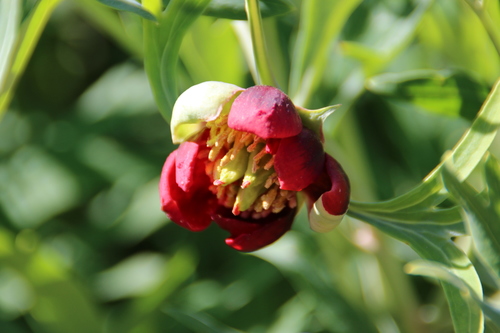


California Peony
paeonia californica
The California Peony (Paeonia californica) is a remarkable herbaceous perennial native exclusively to the coastal sage scrub and chaparral communities of southern California and northern Baja California. Unlike its flamboyant Asian and European cultivated relatives, this wild beauty possesses a subtle, dramatic elegance. It is uniquely adapted to a Mediterranean climate, featuring a winter-growing cycle where it emerges with the first winter rains and completely dies back to its woody rootstock during the hot, dry summer months. Its drooping, nodding flowers are a deep, dark red or purplish-black, resembling elegant, downward-facing cups that shelter delicate pollen-bearing stamens from winter rains. This hardy native plays an important ecological role in fire-prone ecosystems, quickly regenerating from its deep taproots after wildfires. Its presence is a true sign of a healthy, intact coastal sage or chaparral habitat, making it a beloved find for native plant enthusiasts and hikers alike during the late winter and early spring.
Hábitat: Found in coastal sage scrub, chaparral, and dry southern oak woodlands, typically on brushy, south-facing slopes below 1,500 meters.
This plant grows as a bushy clump, typically 35 to 75 centimeters tall, with deeply lobed, segmented leaves that have a bluish-green, glaucous sheen. The flowers are cup-shaped, approximately 2 to 5 centimeters in diameter, and conspicuously nod or droop downward on curved stems. The petals are thick, overlapping, and range in color from deep maroon and dark crimson to almost blackish-purple. Inside the downward-facing bloom, numerous yellow-tipped stamens form a bright, hidden contrast. Following pollination, the flowers develop into star-like clusters of dry, leathery seed pods (follicles) that split open to reveal large, glossy black seeds.
Categoría
PlantasRareza
Common
Peligro
1/5 · Muy bajo
Snaps
¡Sé la primera persona en hacer un snap!
Indigenous peoples, such as the Coahuilla and Kumeyaay, historically used the roots of this plant to brew medicinal teas for treating colds, sore throats, and stomach pain.
The seeds of this plant require a complex double-dormancy cycle involving cold winter temperatures and moisture before they will germinate.
Unlike most ornamental garden peonies which bloom in late spring or summer, the California Peony blooms in the dead of winter, sometimes as early as January.
The plant dies back completely to its underground rootstock during dry summer months, conserving moisture and energy until winter rains return.
Its deep, woody taproot system remains insulated underground during chaparral wildfires, allowing the plant to rapidly sprout and regenerate in the nutrient-rich ash.
The downward-facing posture of its flowers protects the delicate pollen and reproductive organs from winter rains and wind, keeping them dry for pollinators.
As a photosynthetic plant, the California Peony produces its own sugars using sunlight, water, and carbon dioxide, while absorbing essential minerals from the soil.
Bombus vosnesenskii
Provides pollen to native bumblebees who vibrate their wings to release the pollen from the anthers.
Artemisia californica
Grows alongside and competes for sunlight and space on semi-shaded chaparral slopes.
Aún no hay insignias de rasgos asignadas a este objeto.
Todavía no hay alias listados.
Las colecciones para este objeto aparecerán aquí a medida que se añadan más temas.
Peligro
1/5 · Muy bajo
Todavía no hay notas especiales de seguridad.
La forma más fácil de identificar a California Peony es usar la aplicación de identificación de naturaleza Snappit.
35+ cm
10+ años
As a photosynthetic plant, the California Peony produces its own sugars using sunlight, water, and carbon dioxide, while absorbing essential minerals from the soil.
Found in coastal sage scrub, chaparral, and dry southern oak woodlands, typically on brushy, south-facing slopes below 1,500 meters.
Acércate para separar los grupos y explorar dónde se ha fotografiado este objeto.
Los snaps recientes aparecerán aquí a medida que se añadan nuevas observaciones.




_(12743506864).jpg&width=800)












