

Canary Aeonium
aeonium canariense
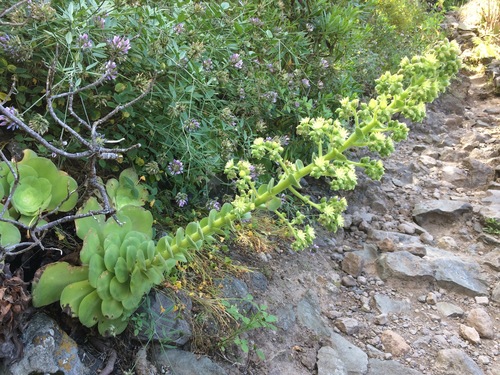
The Canary Aeonium is an impressive, rosette-forming succulent endemic to the Canary Islands, primarily Tenerife. Renowned for its velvet-textured, bright green leaves, this species grows in eye-catching, low-lying clusters that hug rocky basalt cliffs and sun-baked slopes. It is a resilient survivor, adapted to dry Mediterranean climates where it relies on moisture trapped from coastal mists. Its stunning architectural form makes it a highly sought-after plant for rock gardens and dry-scaping around the world. When spring arrives, mature rosettes undergo a dramatic transformation, producing large, cone-shaped clusters of pale yellow flowers that rise majestically from the center of the plant. Since the species is monocarpic, the blooming rosette dies after setting seed, but the plant ensures its survival by producing numerous offsets that carry on the life of the colony.
Hábitat: Thrives on rocky cliffs, stone walls, and sunny, well-drained slopes in coastal and succulent scrub zones of the Canary Islands.
This plant forms a large, flat-topped rosette measuring up to 60 cm in diameter. The leaves are broad, light green, spoon-shaped, and covered with tiny, soft, glandular hairs that give them a distinct velvety and slightly sticky texture. In intense sunlight or drought, the leaf margins may develop a delicate reddish blush. During the blooming season, a central, stout, pyramidal stalk shoots up to 60 cm high, displaying hundreds of tiny star-shaped, pale yellow-green flowers.
Categoría
PlantasRareza
Common
Peligro
1/5 · Muy bajo
Snaps
¡Sé la primera persona en hacer un snap!
The rosettes are monocarpic, meaning the flowering head dies after blooming, but it produces many offsets ('pups') beforehand to keep the plant alive.
The species name 'canariense' refers directly to its native origin in the Canary Islands, where it blankets basalt rock cliffs.
Unlike many succulents with smooth leaves, this species features dense, velvety hairs that give it a unique soft, slightly sticky texture.
Dense, fine hairs on the leaves trap a layer of humid air close to the plant surface, significantly reducing moisture loss from evaporation.
The plant diverts all of its life energy into producing a massive, single seed-bearing inflorescence, sacrificing the main rosette while generating cloning offsets.
A fibrous and shallow root system allows the plant to anchor securely into tiny crevices of volcanic basalt cliffs, exploiting minimal soil pockets.
As a photosynthetic plant, it produces its own energy using sunlight, carbon dioxide, and water absorbed through its shallow root system.
Gallotia galloti
The Tenerife Lizard feeds on the yellow flowers and ripe seeds, occasionally aiding in seed dispersal.
Apis mellifera
Bees visit the massive yellow inflorescences in spring, gathering nectar and pollen while pollinating the flowers.
Aún no hay insignias de rasgos asignadas a este objeto.
Todavía no hay alias listados.
Las colecciones para este objeto aparecerán aquí a medida que se añadan más temas.
Peligro
1/5 · Muy bajo
Todavía no hay notas especiales de seguridad.
La forma más fácil de identificar a Canary Aeonium es usar la aplicación de identificación de naturaleza Snappit.
15-60 cm
0.5-4 kg
3-10 años
As a photosynthetic plant, it produces its own energy using sunlight, carbon dioxide, and water absorbed through its shallow root system.
Thrives on rocky cliffs, stone walls, and sunny, well-drained slopes in coastal and succulent scrub zones of the Canary Islands.
Acércate para separar los grupos y explorar dónde se ha fotografiado este objeto.
Los snaps recientes aparecerán aquí a medida que se añadan nuevas observaciones.








.jpg&width=800)



