

Canary Island Pine
pinus canariensis
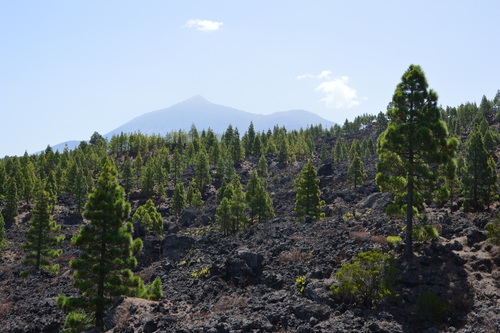
The Canary Island Pine (Pinus canariensis) is a majestic, large evergreen tree endemic to the volcanic archipelago of the Canary Islands off the coast of northwestern Africa. Renowned for its towering, straight trunk and highly resilient nature, it plays a critical role in the local ecology. One of its most fascinating features is its remarkable adaptation to wildfires; unlike most pine species, it can quickly regenerate from buds hidden deep beneath its thick bark after being completely scorched. Furthermore, its exceptionally long needles act as a natural irrigation system by combing moisture from passing fog, sustaining the tree and surrounding flora in otherwise arid, rocky terrains. Whether standing as a charred monument to recent fires or forming a lush, green canopy in subtropical cloud forests, this iconic tree exemplifies survival and endurance in harsh volcanic landscapes.
Hábitat: Found primarily on subtropical volcanic mountainsides, steep rocky slopes, and within dry, high-altitude cloud forests.
This large conifer features a tall, straight trunk that can reach over 40 meters in height, covered in thick, reddish-brown bark that becomes deeply fissured and scaly with age. Its most distinctive visual identifier is its remarkably long, drooping, yellowish-green needles, which grow in distinct bundles of three and can measure up to 30 centimeters in length. The tree's crown is typically conical in its youth, broadening into an umbrella-like canopy as it matures. It produces robust, chestnut-brown cones that are large and heavily scaled, often remaining tightly closed on the branches for years.
Categoría
PlantasRareza
Common
Peligro
1/5 · Muy bajo
Snaps
¡Sé la primera persona en hacer un snap!
It is officially recognized as the natural botanical symbol of the island of La Palma.
The Canary Island Pine is widely considered one of the most fire-resistant conifer species in the entire world.
The resinous heartwood of this tree, known locally as 'tea' wood, is incredibly strong, rot-resistant, and was historically a staple of traditional Canarian architecture.
Through its fog-harvesting abilities, a single mature tree can capture hundreds of liters of water during a dense fog event, creating localized microclimates.
Capable of rapidly regenerating lush green shoots directly from its scorched trunk and thick branches following intense wildfires.
Utilizes its exceptionally long needles to condense moisture from low-hanging clouds and fog, dripping the water directly down to its root zone.
Develops incredibly thick, overlapping layers of bark that physically insulate its vital internal cambium layer from extreme heat and flames.
As an autotrophic plant, it produces its own food through photosynthesis using sunlight, water, and atmospheric gases.
Diferencias por edad: Seedlings require more consistent moisture and soil nutrients until their deep taproots and fog-harvesting needles fully develop.
Fringilla teydea
Feeds exclusively on the seeds of the Canary Island Pine.
Regulus teneriffae
Forages for insects hidden in the pine's thick needle clusters.
Dendrocopos major
Excavates nesting cavities in dead or mature pine trunks and forages under the bark.
Aún no hay insignias de rasgos asignadas a este objeto.
Todavía no hay alias listados.
Las colecciones para este objeto aparecerán aquí a medida que se añadan más temas.
Peligro
1/5 · Muy bajo
Todavía no hay notas especiales de seguridad.
La forma más fácil de identificar a Canary Island Pine es usar la aplicación de identificación de naturaleza Snappit.
1500-4500 cm
2000-25000 kg
150-300 años
As an autotrophic plant, it produces its own food through photosynthesis using sunlight, water, and atmospheric gases.
Found primarily on subtropical volcanic mountainsides, steep rocky slopes, and within dry, high-altitude cloud forests.
Passive Absorption
Acércate para separar los grupos y explorar dónde se ha fotografiado este objeto.
Los snaps recientes aparecerán aquí a medida que se añadan nuevas observaciones.




_Sedum_spathulifolium_-_Flowers_-_Boileau%2C_Bouloc%2C_France.jpg&width=800)







.jpg&width=800)


