

Carolina Crane'S-Bill
geranium carolinianum
Carolina Crane'S-Bill is a hardy annual or biennial herb native to North America, widely recognized for its delicate pale pink to lavender flowers and deeply divided, star-like foliage. It belongs to the geranium family and is frequently found flourishing in disturbed areas, roadsides, and meadows. Despite its modest size, this resilient wildflower plays a vital role in local ecosystems by providing early spring forage for various pollinators. What makes this plant particularly fascinating is its unique reproductive strategy; after flowering, it develops a long, beak-like seed capsule that eventually splits open with explosive force. This ballistic seed dispersal mechanism allows the plant to efficiently colonize new patches of open soil, earning its reputation as a highly successful pioneer species.
Hábitat: Typically found in disturbed soils, old fields, pastures, roadsides, and open woodlands across North America.
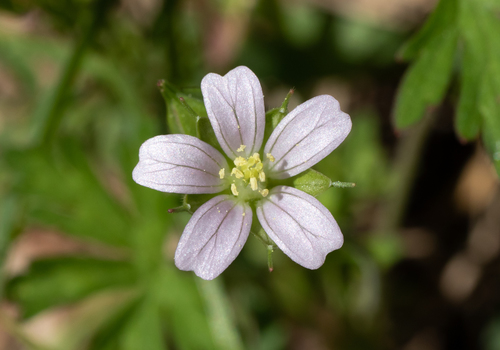
This low-growing plant typically reaches 10 to 40 cm in height, characterized by hairy, branching stems that often display a reddish-purple tinge. Its leaves are deeply divided into five to nine distinct, finger-like lobes, giving them a distinct palm-like appearance. The flowers are small, measuring about 1 cm across, with five pale pink, lavender, or nearly white petals clustered at the ends of the stems. Following pollination, the plant produces distinctive erect, beak-shaped seed pods that resemble the bill of a crane.
Categoría
PlantasRareza
Common
Peligro
1/5 · Muy bajo
Snaps
¡Sé la primera persona en hacer un snap!
It is a pioneer species, meaning it is among the first plants to grow back after a forest fire or heavy agricultural tilling.
Its seeds are a valuable food source for various species of wild birds, including doves and quail.
The common name 'crane's-bill' comes from the shape of the seed capsule, which closely resembles a crane's beak.
When the seed capsule dries, it splits violently, launching seeds up to several meters away to colonize new territory.
The deeply lobed leaves can adjust their orientation slightly to maximize sunlight absorption in competitive, weedy habitats.
Quickly germinates and establishes itself in nutrient-poor or compacted soils before other competing vegetation can take hold.
As a photosynthetic plant, it produces its own energy using sunlight, water, and carbon dioxide while absorbing essential minerals from the soil.
Lasioglossum coriaceum
Pollinated by native sweat bees seeking nectar and pollen.
Odocoileus virginianus
Foliage is occasionally grazed by white-tailed deer.
Aún no hay insignias de rasgos asignadas a este objeto.
Todavía no hay alias listados.
Las colecciones para este objeto aparecerán aquí a medida que se añadan más temas.
Peligro
1/5 · Muy bajo
Todavía no hay notas especiales de seguridad.
La forma más fácil de identificar a Carolina Crane'S-Bill es usar la aplicación de identificación de naturaleza Snappit.
10-40 cm
1-2 años
As a photosynthetic plant, it produces its own energy using sunlight, water, and carbon dioxide while absorbing essential minerals from the soil.
Typically found in disturbed soils, old fields, pastures, roadsides, and open woodlands across North America.
Acércate para separar los grupos y explorar dónde se ha fotografiado este objeto.
Los snaps recientes aparecerán aquí a medida que se añadan nuevas observaciones.





















