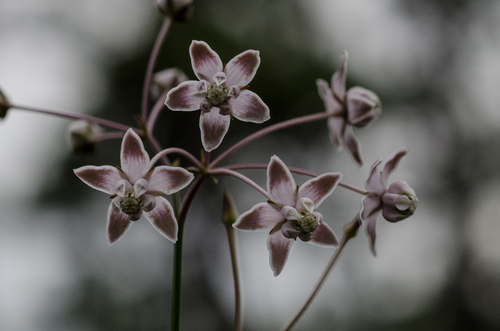


Carolina Milkweed
asclepias cinerea
Carolina Milkweed (Asclepias cinerea) is a delicate and slender perennial wildflower native to the sandy pinelands and savannas of the southeastern United States. Standing quietly amidst wiregrass and longleaf pines, this understated milkweed is characterized by its exceptionally narrow, needle-like leaves and subtle, ash-colored flowers. Unlike some of its more robust and colorful relatives, Carolina Milkweed boasts a quiet, minimalist beauty that blends effortlessly into its native grassy habitats. Historically adapted to fire-maintained ecosystems, this species relies on regular, low-intensity forest fires to clear competing vegetation and stimulate growth. It plays an important role in the local ecology, serving as a larval host plant for monarch and queen butterflies, while offering nectar to specialized native bees and wasps that are strong enough to extract its pollen sacs.
Hábitat: Found in open, sandy pine flatwoods, savannas, and sandhills of the southeastern United States coastal plains.
Carolina Milkweed is a slender, upright herbaceous plant growing 30 to 60 cm tall, often with single or few unbranched stems. Its most distinguishing feature is its extremely narrow, linear, almost thread-like leaves that are 5 to 10 cm long and only a few millimeters wide, arranged oppositely along the stem. The flowers are small and clustered in loose, flat-topped umbels, showing a pale ash-gray, purplish, or greenish-white hue. Each flower has the classic milkweed structure with five reflexed petals pointing downward and five hoods forming a crown, resulting in a complex, star-like appearance close up.
Categoría
PlantasRareza
Common
Peligro
1/5 · Muy bajo
Snaps
¡Sé la primera persona en hacer un snap!
Its leaves are so exceptionally narrow and needle-like that the plant virtually disappears into the surrounding wiregrass when not in bloom.
Like other milkweeds, it produces a sticky white latex sap that can gum up the mouthparts of small insects trying to feed on it.
The species name 'cinerea' comes from the Latin word for 'ash-colored,' directly describing the plant's dusty gray-purple blossoms.
Produces toxic cardenolides (cardiac glycosides) in its tissues, making it unpalatable and poisonous to most generalist herbivores.
Features a deep, resilient taproot that allows the plant to resprout quickly and thrive following natural low-intensity wildfires.
Packages its pollen into specialized sticky sacs called pollinia, which temporarily trap the legs of visiting insects to guarantee pollination.
As an autotrophic plant, Carolina Milkweed generates its own food through photosynthesis, utilizing sunlight, carbon dioxide, and water while absorbing minerals from sandy soils.
Danaus plexippus
Larvae feed exclusively on the foliage of this plant to accumulate defensive toxins.
Bombus pennsylvanicus
Visits the flowers for nectar and acts as an efficient pollinator of the species.
Danaus gilippus
Larvae utilize the leaves as a critical food source during their development.
Aún no hay insignias de rasgos asignadas a este objeto.
Todavía no hay alias listados.
Las colecciones para este objeto aparecerán aquí a medida que se añadan más temas.
Peligro
1/5 · Muy bajo
Todavía no hay notas especiales de seguridad.
La forma más fácil de identificar a Carolina Milkweed es usar la aplicación de identificación de naturaleza Snappit.
30-60 cm
3-8 años
As an autotrophic plant, Carolina Milkweed generates its own food through photosynthesis, utilizing sunlight, carbon dioxide, and water while absorbing minerals from sandy soils.
Found in open, sandy pine flatwoods, savannas, and sandhills of the southeastern United States coastal plains.
Photosynthesis
Acércate para separar los grupos y explorar dónde se ha fotografiado este objeto.
Los snaps recientes aparecerán aquí a medida que se añadan nuevas observaciones.




.jpg&width=800)








