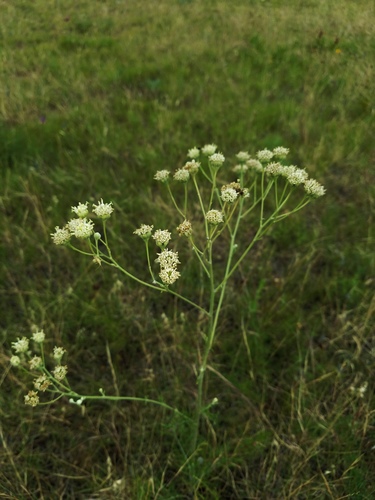


Chalk Hill Hymenopappus
hymenopappus tenuifolius
Chalk Hill Hymenopappus, scientifically known as Hymenopappus tenuifolius, is a hardy biennial or perennial wildflower native to the expansive prairies and grasslands of the central United States. Thriving in harsh, calcium-rich soils where few other plants can survive, this resilient member of the aster family plays a vital role in stabilizing dry soils and supporting local pollinator communities. Its understated elegance is marked by fine, thread-like leaves and clusters of delicate, creamy-white blossoms. This plant is a true survivor, well-adapted to the hot, windy, and dry conditions of the Great Plains, where its deep taproot and woolly coatings provide excellent protection against moisture loss. Nature enthusiasts often find it growing alongside other drought-tolerant flora, marking the presence of unique chalky or limestone-rich soils.
Hábitat: Typically found in dry, rocky or gravelly prairies, limestone glades, gypsum outcrops, and chalky hillsides.
This erect herb typically reaches heights of 30 to 100 centimeters. It features highly divided, slender, almost thread-like green leaves that give the foliage a delicate, feathery appearance. The stems and lower leaf surfaces are often covered in fine, cobwebby or woolly white hairs, which protect the plant from intense sunlight. At the top of the branched stems, it bears small, rounded flower heads in loose, flat-topped clusters. Each flower head consists entirely of numerous tiny, tubular disc florets that range from dull white to cream or pale yellow, completely lacking the large, colorful ray petals common to other asters.
Categoría
PlantasRareza
Common
Peligro
1/5 · Muy bajo
Snaps
¡Sé la primera persona en hacer un snap!
Its species name 'tenuifolius' is Latin for 'slender-leaved', perfectly describing its highly divided, thread-like foliage.
The genus name 'Hymenopappus' translates to 'membrane-pappus', referring to the small, membranous scales that crown the seeds of these plants.
Unlike many other members of the aster family, this species completely lacks ray flowers (the outer 'petals'), giving its flower heads a uniquely round, woolly appearance.
The fine, white cobwebby hairs on its stems and leaves reflect excess sunlight and trap a layer of humid air, dramatically reducing water loss through transpiration.
It develops a deep, sturdy taproot that penetrates far into rocky and chalky soils to access deep-seated water reserves during dry prairie summers.
It has a specialized cellular chemistry that allows it to thrive in high-calcium, alkaline, and nutrient-poor soils that would dehydrate or poison other plant species.
As a photoautotrophic plant, it produces its own food through photosynthesis, utilizing sunlight, carbon dioxide, and water while absorbing key minerals from calcareous soils.
Apis mellifera
Pollinated by various native bees seeking nectar and pollen from the small disc florets.
Danaus plexippus
Provides pollen and nectar to native butterflies during its summer blooming period.
Odocoileus virginianus
Foraged upon by native mammalian herbivores, though its woolly leaves make it less palatable.
Aún no hay insignias de rasgos asignadas a este objeto.
Todavía no hay alias listados.
Las colecciones para este objeto aparecerán aquí a medida que se añadan más temas.
Peligro
1/5 · Muy bajo
Todavía no hay notas especiales de seguridad.
La forma más fácil de identificar a Chalk Hill Hymenopappus es usar la aplicación de identificación de naturaleza Snappit.
30-100 cm
0.05-0.2 kg
2-4 años
As a photoautotrophic plant, it produces its own food through photosynthesis, utilizing sunlight, carbon dioxide, and water while absorbing key minerals from calcareous soils.
Typically found in dry, rocky or gravelly prairies, limestone glades, gypsum outcrops, and chalky hillsides.
Acércate para separar los grupos y explorar dónde se ha fotografiado este objeto.
Los snaps recientes aparecerán aquí a medida que se añadan nuevas observaciones.









.jpg&width=800)






