

Chamois Cress
hornungia alpina
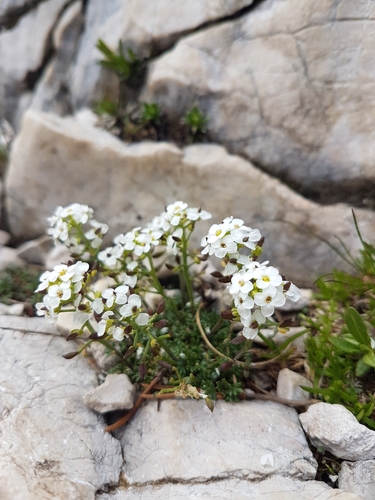
Chamois Cress is a delicate, low-growing perennial herb belonging to the mustard family, Brassicaceae. Native to the high-altitude mountainous regions of Europe, such as the Alps and the Pyrenees, this resilient little plant is beautifully adapted to survive in harsh, rocky environments. Its tiny, bright white flowers form dense clusters that sit atop compact cushions of deeply lobed green leaves. Growing in scree, rock crevices, and mountain meadows, it acts as an important pioneer species, helping to stabilize loose soil on steep mountain slopes. Despite its fragile appearance, Chamois Cress is remarkably tough, relying on a deep taproot to anchor itself and absorb nutrients from sparse alpine soils. For hikers and alpine enthusiasts, finding a patch of Chamois Cress blooming amid barren gray stones is a delightful sign of life's endurance in the high peaks.
Hábitat: Found in high-altitude alpine zones, typically growing in moist calcareous scree, rocky crevices, and gravelly stream beds.
Chamois Cress is a diminutive plant, typically growing between 2 to 15 centimeters in height, forming low-lying rosettes or compact leafy mats. It features deeply pinnate, feather-like dark green leaves that cluster near the base. Its most striking feature is its small terminal clusters of tiny, four-petaled white flowers, with each flower measuring only about 3 to 5 millimeters across. These blooms appear from late spring through summer, eventually producing small, oval-shaped seed pods known as silicles.
Categoría
PlantasRareza
Common
Peligro
1/5 · Muy bajo
Snaps
¡Sé la primera persona en hacer un snap!
Despite growing in freezing climates, its seeds can germinate at extremely low temperatures to make the most of the brief alpine summer.
Its common name, Chamois Cress, directly references the agile mountain goats (chamois) that share its rocky high-altitude habitat.
The plant's scientific genus name, Hornungia, was chosen to honor the 19th-century German botanist and pharmacist Ernst Gottfried Hornung.
Produces specialized intracellular proteins and sugars that act as natural antifreeze, preventing cell wall damage during freezing alpine nights.
Develops a tough, deep taproot that penetrates deep into unstable gravel and rock fissures to secure the plant against high mountain winds.
Utilizes protective pigments in its dense leaf cushions to filter out intense ultraviolet radiation common at high elevations.
As a photoautotrophic plant, Chamois Cress produces its own energy via photosynthesis using sunlight, carbon dioxide, and water, supplemented by minerals absorbed through its roots.
Bombus alpinus
Visits the small white flowers to feed on nectar, transferring pollen between isolated alpine plant populations.
Rupicapra rupicapra
Grazes on alpine vegetation, including the leaves and flowers of Chamois Cress, on high rocky slopes.
Aún no hay insignias de rasgos asignadas a este objeto.
Todavía no hay alias listados.
Las colecciones para este objeto aparecerán aquí a medida que se añadan más temas.
Peligro
1/5 · Muy bajo
Todavía no hay notas especiales de seguridad.
La forma más fácil de identificar a Chamois Cress es usar la aplicación de identificación de naturaleza Snappit.
2-15 cm
0.002-0.015 kg
2-5 años
As a photoautotrophic plant, Chamois Cress produces its own energy via photosynthesis using sunlight, carbon dioxide, and water, supplemented by minerals absorbed through its roots.
Found in high-altitude alpine zones, typically growing in moist calcareous scree, rocky crevices, and gravelly stream beds.
Acércate para separar los grupos y explorar dónde se ha fotografiado este objeto.
Los snaps recientes aparecerán aquí a medida que se añadan nuevas observaciones.