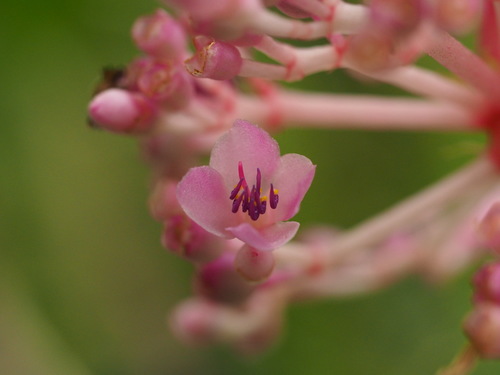


Chandelier Tree
medinilla cumingii
The Chandelier Tree (Medinilla cumingii) is an exquisite tropical shrub native to the damp, humid rainforests of the Philippines. Known for its spectacular cascading clusters of pink to purple flowers, this plant gets its common name from the way its heavy flower panicles dangle from the branches like elegant living chandeliers. In its natural environment, it often grows as an epiphyte, anchoring itself to the trunks of larger trees to access sunlight high in the forest canopy. Highly prized by gardeners and botanists, it brings a vibrant slice of the tropics into greenhouses and shade gardens globally, where its lush foliage and colorful berries provide year-round interest.
Hábitat: Found in humid tropical rainforests, typically growing epiphytically on tree trunks or terrestrially in shaded, damp understories.
This evergreen shrub typically grows between 100 and 250 centimeters tall, featuring sturdy, woody stems and large, leathery, opposite leaves with prominent veins. Its most defining characteristic is the pendulous, multi-branched panicles of small, star-shaped pink flowers. As the blooms mature, they give way to fleshy berries that transition through a striking gradient of colors, from bright pink to a deep, glossy dark purple or blue-black.
Categoría
PlantasRareza
Common
Peligro
1/5 · Muy bajo
Snaps
¡Sé la primera persona en hacer un snap!
Despite its tree-like common name, it is actually a shrub that frequently lives as an epiphyte perched high on other trees.
The fruits are highly ornamental, presenting shades of pink, red, magenta, and dark purple simultaneously on a single stem as they ripen.
The genus Medinilla was named to honor Jose de Medinilla y Pineda, an 1800s governor of the Mariana Islands.
Can grow securely on the branches of other trees, absorbing moisture and nutrients from the air and organic debris without harming its host.
Utilizes specialized poricidal anthers that only release pollen when vibrated at specific frequencies by visiting insect wings.
Produces berries that change color in stages, creating a multi-colored display that continuously attracts seed-dispersing birds.
As a photosynthetic plant, it manufactures its own nutrients from sunlight, water, carbon dioxide, and essential soil minerals.
Loriculus philippensis
Feeds on the ripe purple berries of the Chandelier Tree, assisting in seed dispersal across the forest.
Apis cerana
Visits the star-shaped blossoms to gather nectar and pollen, aiding in the pollination of the shrub.
Aún no hay insignias de rasgos asignadas a este objeto.
Todavía no hay alias listados.
Las colecciones para este objeto aparecerán aquí a medida que se añadan más temas.
Peligro
1/5 · Muy bajo
Todavía no hay notas especiales de seguridad.
La forma más fácil de identificar a Chandelier Tree es usar la aplicación de identificación de naturaleza Snappit.
100-250 cm
1-10 kg
10-30 años
As a photosynthetic plant, it manufactures its own nutrients from sunlight, water, carbon dioxide, and essential soil minerals.
Found in humid tropical rainforests, typically growing epiphytically on tree trunks or terrestrially in shaded, damp understories.
Acércate para separar los grupos y explorar dónde se ha fotografiado este objeto.
Los snaps recientes aparecerán aquí a medida que se añadan nuevas observaciones.


















