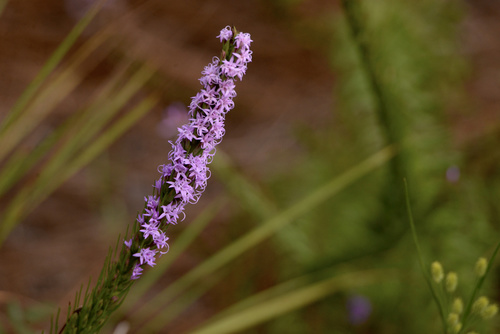


Chapman'S Blazing Star
liatris chapmanii
Chapman's Blazing Star (Liatris chapmanii) is a striking perennial wildflower native to the sandy pinelands and scrub habitats of the southeastern United States, primarily Florida. Rising up with slender, upright stems, this plant is crowned with dense, fuzzy spikes of vibrant purple-magenta blossoms that resemble miniature fireworks. It plays a critical role in its native ecosystem, serving as an oasis of nectar for a wide variety of late-season pollinators. Highly adapted to fire-prone environments, Chapman's Blazing Star thrives in nutrient-poor, sandy soils where many other plants struggle. Its presence is a hallmark of healthy, open sandhill and flatwood communities. Nature lovers and gardeners alike prize it for its unique top-down blooming sequence and its resilience under hot, drought-prone conditions.
Hábitat: Found in open, sunny sandhills, scrubby flatwoods, and dry pine barrens with well-drained, sandy soils.
This plant is easily identified by its stiff, unbranched stems growing 30 to 150 cm tall, lined with narrow, linear green leaves that become smaller as they climb. The defining feature is the dense, brush-like spike of lavender-pink to deep purple flower heads, which lack ray petals and instead consist entirely of fuzzy disc florets. Uniquely, the flowers open from the very top of the spike downward, creating a partially blooming wand of color in late summer.
Categoría
PlantasRareza
Common
Peligro
1/5 · Muy bajo
Snaps
¡Sé la primera persona en hacer un snap!
It is highly drought-tolerant, relying on a bulbous underground stem called a corm that stores water and starch through dry spells.
It is named in honor of Alvan Wentworth Chapman, an influential 19th-century southern botanist who wrote the first comprehensive manual of Southern flora.
Unlike most spiked flowers which bloom from the bottom up, Chapman's Blazing Star defies convention by opening its flowers from the top down.
Possesses a bulbous underground corm that stores energy, enabling the plant to survive intense wildfires and quickly sprout new shoots in the nutrient-rich ash.
Blooms from the top of the spike downward, a rare pattern among flowering spikes that helps maximize pollination opportunities by different insects over time.
Features narrow, needle-like leaves that minimize water loss and a deep root system adapted to dry, nutrient-deficient sandy soils.
As a photoautotrophic plant, it manufactures its own energy from sunlight, carbon dioxide, and water through the process of photosynthesis.
Phoebis sennae
Adult butterflies visit the flowers for nectar, facilitating pollination.
Apis mellifera
Forages on the pollen and nectar, acting as a major pollinator.
Odocoileus virginianus
Browses on the tender green foliage and young flowering spikes.
Aún no hay insignias de rasgos asignadas a este objeto.
Todavía no hay alias listados.
Las colecciones para este objeto aparecerán aquí a medida que se añadan más temas.
Peligro
1/5 · Muy bajo
Todavía no hay notas especiales de seguridad.
La forma más fácil de identificar a Chapman'S Blazing Star es usar la aplicación de identificación de naturaleza Snappit.
30-150 cm
3-10 años
As a photoautotrophic plant, it manufactures its own energy from sunlight, carbon dioxide, and water through the process of photosynthesis.
Found in open, sunny sandhills, scrubby flatwoods, and dry pine barrens with well-drained, sandy soils.
Acércate para separar los grupos y explorar dónde se ha fotografiado este objeto.
Los snaps recientes aparecerán aquí a medida que se añadan nuevas observaciones.














.jpg&width=800)





