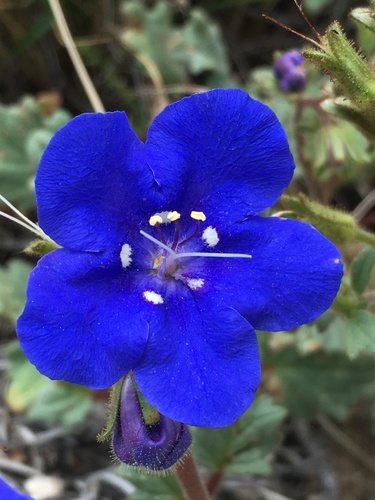


Charlotte'S Phacelia
phacelia nashiana
Charlotte's Phacelia (Phacelia nashiana) is a captivating annual wildflower endemic to the arid and semi-arid regions of Southern California. Often found hugging the gravelly slopes where the southern Sierra Nevada transitions into the Mojave Desert, this resilient little plant bursts into life during the spring. It is highly admired by botanists and hikers alike for its striking, intense blue flowers that offer a vibrant contrast against the sandy, muted desert soils. As an annual, it relies heavily on timely winter rains to germinate and carpet the desert floor in a sea of cobalt, making its seasonal appearances both precious and eagerly anticipated. Beyond its sheer beauty, Charlotte's Phacelia plays an important ecological role, acting as a crucial early-season nectar source for native desert pollinators when few other resources are available.
Hábitat: Found in dry, sandy or gravelly soils on desert slopes, pinyon-juniper woodlands, and Joshua tree woodlands.
This low-growing herbaceous annual typically reaches heights of 5 to 20 centimeters, featuring erect, hairy stems that can branch near the base. The leaves are deeply lobed or divided, covered in fine, bristly hairs that give them a slightly greyish-green texture. Its most defining feature is the stunning, bell-shaped or bowl-shaped flower, which displays an exceptionally intense deep-blue to violet-blue hue. Each five-lobed flower measures about 1 to 1.5 centimeters across and often highlights a pale or white center, decorated with prominent stamens that protrude elegantly from the throat.
Categoría
PlantasRareza
Common
Peligro
1/5 · Muy bajo
Snaps
¡Sé la primera persona en hacer un snap!
Charlotte's Phacelia is named after Charlotte N. Smith, an active amateur botanist who collected California plants in the mid-20th century.
It is a 'fire follower' or disturbance-adapted species, sometimes appearing in massive, spectacular numbers the spring after a desert wildfire.
Some Phacelia species are known as 'scorpion weeds' because their unfurling flower coils resemble a scorpion's tail, though Phacelia nashiana is relatively compact.
The seeds possess built-in dormancy mechanisms that allow them to remain viable in desert soils for years, germinating rapidly only when winter rainfall is sufficient.
The stems and leaves are covered in dense, bristly hairs that trap a boundary layer of moisture, reducing water loss from harsh desert winds.
The stark contrast between the bright blue petals and the pale center acts as a highly visible target for bees, maximizing pollination efficiency in sparse desert landscapes.
As a photoautotrophic plant, Charlotte's Phacelia produces its own food through photosynthesis, utilizing sunlight, carbon dioxide, and water.
Bombus crotchii
Pollinated by native solitary bees searching for nectar and pollen.
Gopherus agassizii
Provides foliage that may occasionally be browsed by desert tortoises.
Aún no hay insignias de rasgos asignadas a este objeto.
Todavía no hay alias listados.
Las colecciones para este objeto aparecerán aquí a medida que se añadan más temas.
Peligro
1/5 · Muy bajo
Todavía no hay notas especiales de seguridad.
La forma más fácil de identificar a Charlotte'S Phacelia es usar la aplicación de identificación de naturaleza Snappit.
5-30 cm
1 años
As a photoautotrophic plant, Charlotte's Phacelia produces its own food through photosynthesis, utilizing sunlight, carbon dioxide, and water.
Found in dry, sandy or gravelly soils on desert slopes, pinyon-juniper woodlands, and Joshua tree woodlands.
Acércate para separar los grupos y explorar dónde se ha fotografiado este objeto.
Los snaps recientes aparecerán aquí a medida que se añadan nuevas observaciones.