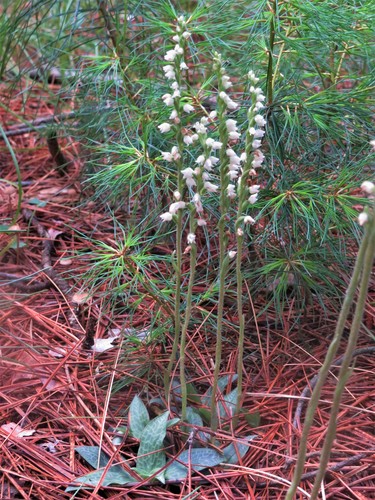


Checkered Rattlesnake Plantain
goodyera tesselata
The Checkered Rattlesnake Plantain (Goodyera tesselata) is a charming, terrestrial orchid native to the cool, moist forests of northeastern North America. Far from being a weed, this delicate perennial orchid is celebrated by botanists and hikers alike for its beautifully variegated foliage and subtle elegance. It grows slowly in the rich, acidic humus of coniferous and mixed hardwood forests, forming small, loose colonies. What makes this plant particularly fascinating is its complex, obligate relationship with underground mycorrhizal fungi, which are essential for its seed germination and ongoing nutrient absorption. While it produces a slender spike of small, white, tubular flowers in mid-to-late summer, it is the striking, tessellated evergreen leaves that truly captivate onlookers throughout the year.
Hábitat: Found in cool, moist, acidic soils of coniferous and mixed deciduous forests, often growing amidst mosses and leaf litter under hemlocks, pines, and birches.
This small orchid is easily recognized by its basal rosette of blue-green to dark green leaves, which are adorned with a distinctive network of pale green or white veins, creating a checkered or tessellated pattern. The leaves are ovate to lanceolate, measuring about 2 to 7 cm in length. In mid-summer, it sends up a single, fuzzy flowering stalk that reaches 10 to 35 cm in height, bearing a spiral or one-sided spike of 10 to 30 tiny, hooded, cream-white flowers. Each flower is only about 4 to 6 mm long, with a pouch-like lower lip.
Categoría
PlantasRareza
Common
Peligro
1/5 · Muy bajo
Snaps
¡Sé la primera persona en hacer un snap!
Its seeds are so tiny and dust-like that they contain no food reserves at all, depending entirely on a fungal host to feed them until they can grow leaves.
The common name Rattlesnake Plantain was coined because early European settlers believed the snake-like patterning of the leaves resembled a rattlesnake's skin, and used it as a folk remedy for snakebites.
The species name 'tesselata' comes from the Latin word for 'mosaic' or 'tiled,' referring directly to the beautiful checkered pattern on the upper surface of the leaves.
Because its microscopic seeds lack endosperm, this orchid relies entirely on symbiotic soil fungi to provide essential nutrients and water for germination and early growth.
The intricate, pale vein patterns on its leaves break up the plant's outline against the dappled light of the forest floor, helping to deter herbivores and optimize light capture.
Its basal leaves remain green throughout the freezing winter months, allowing the plant to begin photosynthesis immediately when spring temperatures rise.
As a photosynthetic plant, it generates its own energy from sunlight, water, and carbon dioxide, while relying on mycorrhizal fungi for mineral absorption.
Diferencias por edad: As a dust-like seed and protocorm, it is completely heterotrophic, relying entirely on mycorrhizal fungi for food before developing green leaves.
Ceratobasidium cornigerum
A vital mycorrhizal fungus partner that infects the orchid's roots to assist in nutrient transfer and seed germination.
Bombus impatiens
Visits the small, nectar-producing flowers in late summer, acting as a primary pollinator.
Odocoileus virginianus
Occasionally grazes on the basal rosettes and flower stalks of this forest orchid.
Aún no hay insignias de rasgos asignadas a este objeto.
Todavía no hay alias listados.
Las colecciones para este objeto aparecerán aquí a medida que se añadan más temas.
Peligro
1/5 · Muy bajo
Todavía no hay notas especiales de seguridad.
La forma más fácil de identificar a Checkered Rattlesnake Plantain es usar la aplicación de identificación de naturaleza Snappit.
10-35 cm
0.01-0.05 kg
5-20 años
As a photosynthetic plant, it generates its own energy from sunlight, water, and carbon dioxide, while relying on mycorrhizal fungi for mineral absorption.
Found in cool, moist, acidic soils of coniferous and mixed deciduous forests, often growing amidst mosses and leaf litter under hemlocks, pines, and birches.
Acércate para separar los grupos y explorar dónde se ha fotografiado este objeto.
Los snaps recientes aparecerán aquí a medida que se añadan nuevas observaciones.



















