

Chilean Rhubarb
gunnera tinctoria
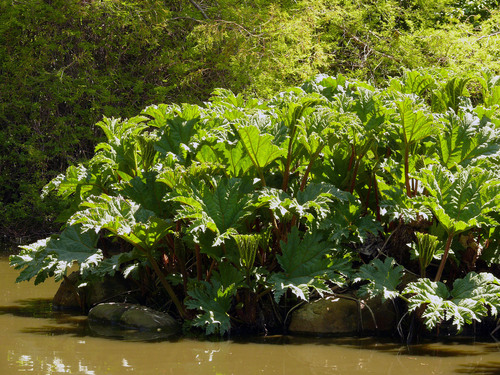
Chilean Rhubarb is a spectacular, giant herbaceous plant known for its dramatic, prehistoric appearance and colossal leaves. Despite its common name, it is completely unrelated to culinary rhubarb, instead belonging to the ancient Gunneraceae family. Native to the damp rainforests and coastal regions of southern Chile and Argentina, this architectural marvel is highly prized in dramatic landscaping but has also gained notoriety as a highly aggressive invasive species in wet temperate zones like Ireland, Great Britain, and New Zealand. It dominates damp habitats by casting dense shade that suppresses native flora.
Hábitat: Thrives in damp, coastal areas, stream banks, wet grasslands, and boggy soils.
This massive plant is easily identified by its giant, umbrella-like leaves that can grow up to 2.5 meters across. The leaves are circular, palmately lobed, and incredibly rough to the touch, with a sandpaper-like texture. Thick, fleshy leaf stalks (petioles) are covered in reddish, prickle-like spikes. From the center of the plant, stout, cone-shaped flowering spikes up to 1 meter tall emerge, packed with thousands of tiny, inconspicuous reddish-green flowers that eventually produce small, fleshy orange-red berries.
Categoría
PlantasRareza
Common
Peligro
1/5 · Muy bajo
Snaps
¡Sé la primera persona en hacer un snap!
A single mature Chilean Rhubarb plant can produce up to 250,000 seeds in a single year, which are easily spread by water and birds.
The Mapuche people of South America traditionally used the roots of the Chilean Rhubarb to extract a strong black dye for coloring wool textiles.
The acidic leaf stalks are technically edible and are consumed raw with salt or sugar in traditional Chilean cuisine, despite their astringency.
Hosts symbiotic cyanobacteria of the genus Nostoc within specialized glands on its stems, allowing it to extract nitrogen directly from the air and thrive in nutrient-poor soils.
Grows gargantuan leaves rapidly in the spring, blocking up to ninety-nine percent of light from reaching the ground to suppress competing vegetation.
Can regenerate entirely from small fragments of its thick, underground rhizomes, making it highly resilient to physical clearing.
As a photoautotroph, it synthesizes its own organic compounds using sunlight, carbon dioxide, and water, heavily supplemented by nitrogen provided by symbiotic cyanobacteria.
Pteridium aquilinum
Provides shelter and maintains moisture in damp environments, but its dense canopy heavily outcompetes native ferns.
Nostoc punctiforme
Houses the nitrogen-fixing cyanobacteria inside its stem tissues in a vital mutualistic relationship.
Ovis aries
Introduced sheep occasionally graze on the young, less prickly leaves of the plant in coastal pastures.
Aún no hay insignias de rasgos asignadas a este objeto.
Todavía no hay alias listados.
Las colecciones para este objeto aparecerán aquí a medida que se añadan más temas.
Peligro
1/5 · Muy bajo
Todavía no hay notas especiales de seguridad.
La forma más fácil de identificar a Chilean Rhubarb es usar la aplicación de identificación de naturaleza Snappit.
150-300 cm
10-150 kg
10-50 años
As a photoautotroph, it synthesizes its own organic compounds using sunlight, carbon dioxide, and water, heavily supplemented by nitrogen provided by symbiotic cyanobacteria.
Thrives in damp, coastal areas, stream banks, wet grasslands, and boggy soils.
Acércate para separar los grupos y explorar dónde se ha fotografiado este objeto.
Los snaps recientes aparecerán aquí a medida que se añadan nuevas observaciones.









_Lin._Erbario_Frizzi_Perugia_n._2126.jpg&width=800)