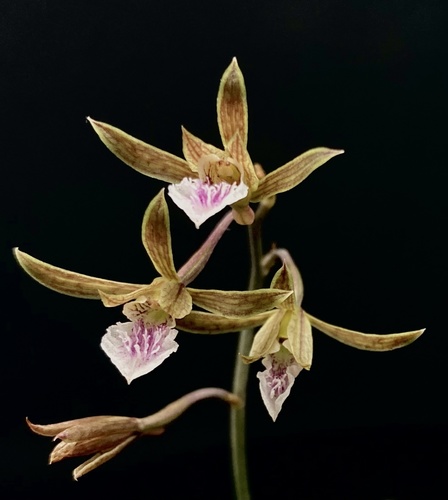


Chinese Crown Orchid
eulophia graminea
The Chinese Crown Orchid (Eulophia graminea) is a hardy terrestrial orchid native to tropical and subtropical Asia. Unlike most orchids that grow on trees, this species thrives directly on the ground. Over the past few decades, it has gained notoriety as an invasive species in North America, particularly in Florida, where it has adapted incredibly well to suburban landscapes. It is highly resilient, capable of spreading rapidly in woodchip mulch and disturbed soils. What makes this orchid particularly fascinating is its unique survival strategy. It grows from large, prominent, green pseudobulbs that sit exposed on the soil surface, resembling small, pale-green onions. From these bulbs, it sends up grass-like leaves and tall, branched flowering spikes. While many orchid lovers treasure rare species, the Chinese Crown Orchid's aggressive colonizing habits make it a formidable weed, showcasing the incredible adaptability of the Orchidaceae family.
Hábitat: Typically found in disturbed soils, suburban lawns, landscaped garden beds rich in woodchip mulch, as well as open pine flatwoods and coastal dunes.
This orchid is characterized by its large, green, fleshy, ovoid pseudobulbs (3 to 5 cm in diameter) that grow at or just below the soil surface, often clustered together. Its leaves are long, narrow, and grass-like, reaching up to 30 cm in length. During the blooming season, it produces a tall, erect, often branched flowering stem that can reach 30 to 100 cm in height. The small, delicate flowers (about 1.5 to 2.5 cm wide) feature five greenish-brown, lance-shaped petals and a distinctive three-lobed white lip with light pink or rose-purple veins and tiny fleshy hairs.
Categoría
PlantasRareza
Common
Peligro
1/5 · Muy bajo
Snaps
¡Sé la primera persona en hacer un snap!
Due to its preference for landscaped areas, this species is commonly nicknamed the 'mulch orchid' by gardeners and botanists in the United States.
Its seeds are so tiny and lightweight that they resemble fine dust, allowing them to hitchhike undetected inside bags of commercial wood mulch.
Unlike many delicate tropical orchids, the Chinese Crown Orchid can tolerate lawnmowers, drought, and even moderate frost due to its hardy underground structure.
The prominent, onion-like pseudobulbs act as highly efficient water and nutrient storage organs, allowing the plant to survive prolonged dry spells.
It is uniquely adapted to utilize decaying organic matter, allowing it to rapidly colonize and flourish in woodchip mulch where other plants struggle.
It produces massive quantities of microscopic, dust-like seeds that are easily carried by light wind currents over vast distances to colonize new areas.
As an autotrophic plant, it produces its own energy via photosynthesis while relying on a symbiotic fungal relationship to absorb essential soil minerals.
Tulasnella violea
Establishes a critical subterranean symbiotic relationship where the fungus provides nutrients to germinating orchid seeds.
Halictus ligatus
Attracted to the small nectar-producing flowers, aiding in cross-pollination.
Aún no hay insignias de rasgos asignadas a este objeto.
Todavía no hay alias listados.
Las colecciones para este objeto aparecerán aquí a medida que se añadan más temas.
Peligro
1/5 · Muy bajo
Todavía no hay notas especiales de seguridad.
La forma más fácil de identificar a Chinese Crown Orchid es usar la aplicación de identificación de naturaleza Snappit.
30-100 cm
3-8 años
As an autotrophic plant, it produces its own energy via photosynthesis while relying on a symbiotic fungal relationship to absorb essential soil minerals.
Typically found in disturbed soils, suburban lawns, landscaped garden beds rich in woodchip mulch, as well as open pine flatwoods and coastal dunes.
Acércate para separar los grupos y explorar dónde se ha fotografiado este objeto.
Los snaps recientes aparecerán aquí a medida que se añadan nuevas observaciones.















