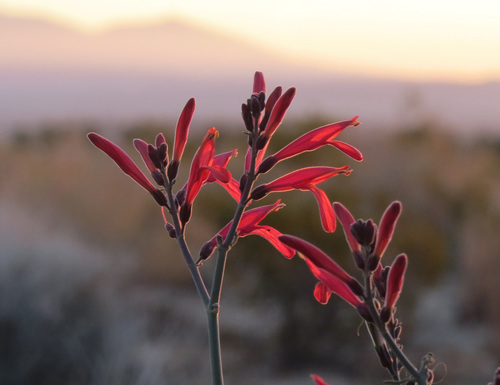


Chuparosa
justicia californica
The Chuparosa (Justicia californica) is a striking, perennial desert shrub native to the Sonoran Desert of the southwestern United States and northern Mexico. Growing in tangled, sprawling clumps, this resilient plant is famous for its vibrant displays of tubular red flowers that stand out brilliantly against the arid landscape. Because it is highly adapted to drought conditions, the Chuparosa frequently drops its leaves, presenting as a mass of succulent-like gray-green stems that continue to photosynthesize even in the harshest dry seasons. This species plays a critical ecological role in its native desert habitat, serving as an invaluable nectar source for hummingbirds, which act as its primary pollinators.
Hábitat: Found in desert washes, rocky canyons, and sandy slopes below 1,000 meters elevation in arid regions.
A deciduous, multi-branched shrub reaching heights of up to 150 cm, characterized by a dense, rounded tangle of succulent-like, dull gray-green stems. Its leaves are small, oval, and sparse, appearing briefly after rainfall before dropping. The most prominent identifier is the abundance of tubular, two-lipped flowers measuring 2 to 3 cm long, colored in brilliant shades of fiery red, orange, or occasionally yellow, clustering along the branches.
Categoría
PlantasRareza
Common
Peligro
1/5 · Muy bajo
Snaps
¡Sé la primera persona en hacer un snap!
Because it drops its leaves to survive drought, this plant is functionally leafless for most of its active flowering and growth cycles.
The common name 'Chuparosa' is a regional Spanish colloquialism meaning 'hummingbird', a nod to the birds that constantly swarm the plant.
The sweet-tasting flowers are entirely edible and have a mild flavor reminiscent of fresh cucumber.
Quickly sheds leaves during dry spells to prevent moisture loss, entering a semi-dormant state while surviving on minimal water.
Utilizes chlorophyll-rich green stems to carry out photosynthesis even when entirely leafless, maximizing energy production in harsh conditions.
Produces bright tubular flowers evolved specifically to fit the long bills of hummingbirds, ensuring highly effective pollination.
Creates its own food by capturing solar energy and carbon dioxide, while absorbing essential water and mineral nutrients through its root system.
Calypte costae
Provides critical nectar during winter and spring nesting seasons.
Ovis canadensis nelsoni
Frequently browses on the tender stems and leaves during drought periods.
Archilochus alexandri
Feeds on nectar and assists in cross-pollination of flowers.
Aún no hay insignias de rasgos asignadas a este objeto.
Todavía no hay alias listados.
Las colecciones para este objeto aparecerán aquí a medida que se añadan más temas.
Peligro
1/5 · Muy bajo
Todavía no hay notas especiales de seguridad.
La forma más fácil de identificar a Chuparosa es usar la aplicación de identificación de naturaleza Snappit.
100-150 cm
15-50 años
Creates its own food by capturing solar energy and carbon dioxide, while absorbing essential water and mineral nutrients through its root system.
Found in desert washes, rocky canyons, and sandy slopes below 1,000 meters elevation in arid regions.
Photosynthesis
Acércate para separar los grupos y explorar dónde se ha fotografiado este objeto.
Los snaps recientes aparecerán aquí a medida que se añadan nuevas observaciones.

Arizona, US
Puedes ver Chuparosa, Verdín y American Threefold.
Ver guía →

California, US
Puedes ver Arbusto De Creosota, Incienso y Beavertail Pricklypear.
Ver guía →
California, US
Puedes ver Arbusto De Creosota, Incienso y Beavertail Pricklypear.
Ver guía →