

Clustered Mountainmint
pycnanthemum muticum
Clustered Mountainmint, also known as blunt mountainmint, is a robust, clump-forming perennial herb native to the eastern half of North America. Renowned for its exceptional pollinator-attracting capabilities, this plant is considered a powerhouse in any native habitat garden or conservation plot. When its dense foliage is bruised or crushed, it releases a potent, pleasant, spearmint-like aroma that serves as a highly effective natural deterrent against various mammalian browsers. Highly adaptable and easy to grow, it thrives in a variety of soil types and is frequently utilized for erosion control and native meadow restoration.
Hábitat: Found in open woodlands, moist meadows, fields, pastures, and wet pine barrens across eastern North America.
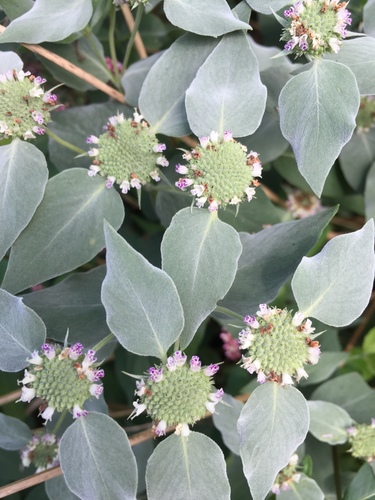
This upright perennial typically grows between 60 to 90 centimeters tall, featuring square stems characteristic of the mint family. The small, tubular flowers are white to pale lavender, often dotted with purple spots, and are tightly packed into dense, flat-topped clusters. What makes the plant highly distinct are the prominent, silvery-white leaf-like bracts located directly beneath the flower clusters, giving the top of the plant an eye-catching 'frosted' or powdery appearance. The lance-shaped, aromatic leaves are arranged oppositely along the stem and have finely toothed margins.
Categoría
PlantasRareza
Common
Peligro
1/5 · Muy bajo
Snaps
¡Sé la primera persona en hacer un snap!
Despite its common name, Clustered Mountainmint does not require a mountainous habitat and is highly successful in low-lying coastal plains.
The bright, silvery-white bracts beneath the flower clusters function like physical landing lights, reflecting ultraviolet light to guide pollinators directly to the small blossoms.
The chemical compound pulegone found in its leaves is a natural insect repellent often used to deter mosquitoes, fleas, and ticks.
Produces high concentrations of pulegone and other essential oils in its foliage, rendering it unpalatable to deer and rabbits.
Secretes massive quantities of nectar, making it one of the single most attractive native plants for a wide array of beneficial insects.
Spreads via vigorous underground rhizomes to form dense colonies, which effectively control soil erosion.
As a photosynthetic plant, it manufactures its own energy from sunlight, water, carbon dioxide, and essential soil minerals.
Bombus pensylvanicus
Provides a crucial summer nectar source for this declining native pollinator.
Danaus plexippus
Adult butterflies feed heavily on the easily accessible flower nectar to fuel flight and migration.
Aphis gossypii
Occasionally targeted by sap-sucking insects that feed on plant juices.
Aún no hay insignias de rasgos asignadas a este objeto.
Todavía no hay alias listados.
Las colecciones para este objeto aparecerán aquí a medida que se añadan más temas.
Peligro
1/5 · Muy bajo
Todavía no hay notas especiales de seguridad.
La forma más fácil de identificar a Clustered Mountainmint es usar la aplicación de identificación de naturaleza Snappit.
60-90 cm
3-10 años
As a photosynthetic plant, it manufactures its own energy from sunlight, water, carbon dioxide, and essential soil minerals.
Found in open woodlands, moist meadows, fields, pastures, and wet pine barrens across eastern North America.
Acércate para separar los grupos y explorar dónde se ha fotografiado este objeto.
Los snaps recientes aparecerán aquí a medida que se añadan nuevas observaciones.