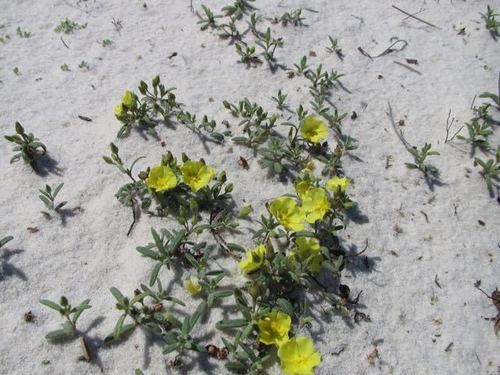


Coastalsand Frostweed
crocanthemum arenicola
The Coastalsand Frostweed (Crocanthemum arenicola) is a resilient, low-growing perennial herb endemic to the coastal sand dunes and sandhills of the southeastern United States. Thriving in harsh, nutrient-poor sandy soils, this member of the rockrose family (Cistaceae) produces charming, bright yellow flowers that open to catch the morning sun. Known for its ability to withstand intense coastal winds, high salt exposure, and blazing heat, this humble plant plays a critical role in stabilizing fragile dune ecosystems. Its common name, "frostweed," comes from a fascinating phenomenon where, during early winter, sap freezing inside the stem bursts through the bark, creating delicate, ice-ribbon sculptures at the plant's base. It represents a beautiful adaptation to seasonal temperature fluctuations and adds a touch of winter magic to coastal landscapes.
Hábitat: Found in open, sunny coastal sand dunes, sand pine scrubs, and dry, maritime grasslands with well-drained, sandy soils.
Coastalsand Frostweed is a compact, multi-stemmed perennial reaching heights of 10 to 30 cm. Its leaves are small, linear to narrowly elliptic, and covered in fine, grayish-pubescent hairs that give the plant a dusty, woolly, or silvery-green appearance to conserve moisture. The flowers are small, about 1.5 to 2 cm wide, featuring five distinct, delicate bright yellow petals and a dense cluster of central yellow stamens. These blooms open primarily in the morning and often shed their petals by afternoon.
Categoría
PlantasRareza
Common
Peligro
1/5 · Muy bajo
Snaps
¡Sé la primera persona en hacer un snap!
Despite being called 'frostweed', it is native to warm, subtropical coastal regions where hard freezes are rare, making the winter ice ribbons a highly dramatic sight.
The delicate ribbons of ice produced by the stems during frosts are formed purely by physical pressure, not by active biological processes of the dormant plant.
The flowers exhibit heliotropism, turning their faces to track the sun during the morning hours before shedding their petals in the afternoon heat.
During the first hard freeze, water pressure pushes sap through microscopic splits in the lower stem, creating intricate, curly ice crystals known as frost flowers.
The dense, gray-white hairs covering its foliage trap a boundary layer of air, dramatically reducing water loss from transpiration during hot, coastal winds.
Its deep, fibrous root system allows it to anchor firmly in shifting sands, helping to hold the fragile dune structure together.
As a photosynthetic plant, it synthesizes its own food using sunlight, water, carbon dioxide, and essential soil minerals.
Habropoda laboriosa
Pollinated by various native bees seeking nectar and pollen during the spring and summer blooming periods.
Sylvilagus palustris
Occasionally browsed by native rabbits in coastal dune systems, though they generally prefer more succulent vegetation.
Uniola paniculata
Competes for space and resources with other sand-dwelling dune plants in the harsh, low-nutrient maritime environments.
Aún no hay insignias de rasgos asignadas a este objeto.
Todavía no hay alias listados.
Las colecciones para este objeto aparecerán aquí a medida que se añadan más temas.
Peligro
1/5 · Muy bajo
Todavía no hay notas especiales de seguridad.
La forma más fácil de identificar a Coastalsand Frostweed es usar la aplicación de identificación de naturaleza Snappit.
10-30 cm
3-8 años
As a photosynthetic plant, it synthesizes its own food using sunlight, water, carbon dioxide, and essential soil minerals.
Found in open, sunny coastal sand dunes, sand pine scrubs, and dry, maritime grasslands with well-drained, sandy soils.
Acércate para separar los grupos y explorar dónde se ha fotografiado este objeto.
Los snaps recientes aparecerán aquí a medida que se añadan nuevas observaciones.

















