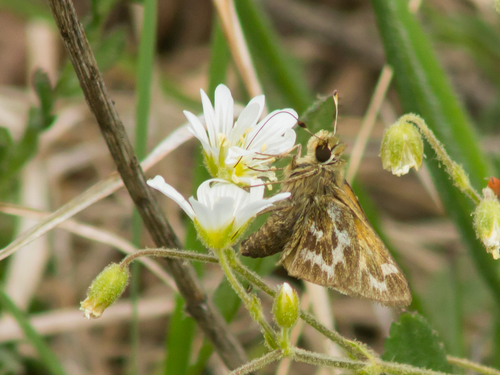


Cobweb Skipper
hesperia metea
A small but striking butterfly, the Cobweb Skipper (Hesperia metea) earns its whimsical name from the intricate, web-like white veins crisscrossing the underside of its hindwings. Flying close to the ground in rapid, darting bursts characteristic of the skipper family, it serves as an early herald of spring in dry, open habitats like pine barrens, rocky glades, and prairies. As a species deeply tied to specific native bunchgrasses for its larval development, the Cobweb Skipper is a fascinating example of localized ecological specialization. Though small and easily overlooked due to its primarily brown upper wings, catching a glimpse of its delicate wing pattern is a true treat for sharp-eyed nature enthusiasts exploring eastern North American woodlands.
Hábitat: Found in dry, open environments with poor soils, such as pine barrens, rocky glades, dry prairies, and open oak woodlands.
The Cobweb Skipper is a small butterfly with a wingspan ranging from 2.5 to 3.5 centimeters. The upperside of its wings is predominantly dark brown, often featuring a subtle yellowish-orange dusting and a few indistinct pale spots. Its most distinguishing feature lies on the underside of the hindwing: striking white veins stand out sharply against a darker, grayish-brown background, creating the distinctive "cobweb" pattern. Males possess a conspicuous dark stigma (a specialized scent-producing patch) on their forewings, while females tend to be slightly larger and darker overall, with more prominent pale spots on their upper wings.
Categoría
InsectosRareza
Common
Peligro
1/5 · Muy bajo
Snaps
¡Sé la primera persona en hacer un snap!
Because they rely heavily on early-successional, dry habitats, intentional prescribed burns are often used by conservationists to manage and maintain their ecosystem.
The Cobweb Skipper earns its common name from the striking white veins on the underside of its hindwings, which closely resemble a spider's web.
They are among the very first non-overwintering butterflies to emerge as adults in the spring, making them a welcome sight for early-season butterfly watchers.
Unlike many butterflies that rest with wings fully open or completely closed, skippers often rest in a 'jet plane' position with forewings and hindwings held at different angles.
Equipped with powerful flight muscles in a stout thorax, this butterfly can fly in remarkably quick, erratic bursts to evade predators.
As an early spring flyer, it frequently lands on bare earth and opens its wings at a distinct V-angle to absorb solar radiation and warm its flight muscles.
The caterpillars are highly specialized architects, spinning elaborate silken tubes at the base of native bunchgrasses to hide from predators while feeding.
Caterpillars feed exclusively on the blades of specific native bunchgrasses, while adult butterflies drink nectar from early spring flowers.
Diferencias por edad: Larvae are completely folivorous, consuming grass blades, whereas adults feed exclusively on floral nectar.
Schizachyrium scoparium
Larvae rely heavily on this native grass as a primary food source and structural support for their silken shelters.
Fragaria virginiana
Adults frequently visit these early-blooming plants to consume nectar, aiding in pollination.
Polistes spp.
Skipper caterpillars are commonly preyed upon by predatory wasps that forage in the grass layers.
Aún no hay insignias de rasgos asignadas a este objeto.
Todavía no hay alias listados.
Las colecciones para este objeto aparecerán aquí a medida que se añadan más temas.
Peligro
1/5 · Muy bajo
Todavía no hay notas especiales de seguridad.
La forma más fácil de identificar a Cobweb Skipper es usar la aplicación de identificación de naturaleza Snappit.
1-2 cm
2-3 cm
0.0001-0.0005 kg
1 años
25 km/h
Caterpillars feed exclusively on the blades of specific native bunchgrasses, while adult butterflies drink nectar from early spring flowers.
Found in dry, open environments with poor soils, such as pine barrens, rocky glades, dry prairies, and open oak woodlands.
Acércate para separar los grupos y explorar dónde se ha fotografiado este objeto.
Los snaps recientes aparecerán aquí a medida que se añadan nuevas observaciones.













_on_Arctostaphylos_parryana%E2%80%94RPBG_(14636065667).jpg&width=800)





