

Colonus Hesperus
colonus hesperus
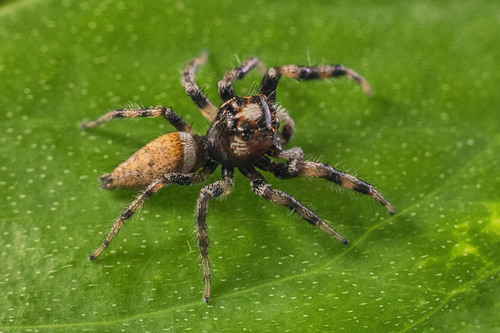
Colonus hesperus, commonly known as the western colonus jumping spider, is a small, charismatic member of the jumping spider family Salticidae native to North America. Known for their curiosity and active, daytime hunting strategies, these spiders do not spin webs to catch prey but instead rely on their outstanding vision and remarkable leaping ability. They are frequently observed exploring foliage, low vegetation, and sunny surfaces in search of small insects. With their highly expressive, large forward-facing eyes, they possess a level of situational awareness that often makes them appear to watch human observers, a trait that makes them highly endearing to nature enthusiasts and arachnologists alike.
Hábitat: Typically found in open grassy fields, oak woodlands, gardens, and low-lying shrubs across the western United States and Mexico.
This minute spider typically measures between 5 to 10 millimeters in length, featuring a compact, athletic body characteristic of jumping spiders. Its coloration is generally a mixture of tan, pale yellow, and brown, with distinct darker markings or stripes on the abdomen and a somewhat pale or translucent appearance on its legs. Females are typically larger and more robustly built, while males often exhibit more pronounced coloration and longer front legs used in courtship displays. The most prominent identification feature is their arrangement of eight eyes, with the two central anterior eyes being exceptionally large, giving them an inquisitive, headlight-like appearance.
Categoría
InvertebrateRareza
Common
Peligro
1/5 · Muy bajo
Snaps
¡Sé la primera persona en hacer un snap!
Male jumping spiders perform complex dances, waving their pedipalps and front legs, to convince females they are mates rather than a potential meal.
They possess a unique retina-shifting ability where they can move their inner eyes to track objects without moving their external lens or head.
Unlike web-building spiders, Colonus hesperus relies on its incredible 360-degree vision to track and stalk prey from several inches away.
By suddenly increasing the fluid pressure in their legs, they can leap up to 40 times their body length without needing muscular legs.
Their massive primary eyes function like telephoto lenses, providing exceptional spatial resolution and color vision to track prey.
Before attempting any leap, they anchor a dragline of silk to their starting point, ensuring they can climb back up if they miss.
An active predator that hunts small insects and other spiders by stalking them closely before executing a precise leap.
Diferencias por edad: Spiderlings feed on smaller soft-bodied insects like fruit flies, graduating to larger insects as they mature.
Myzus persicae
Preys upon common agricultural pests found in the same foliage.
Sceliphron caementarium
A frequent predator of small jumping spiders, hunting them around vegetation.
Phidippus audax
Competes for the same small insect prey in grassland habitats.
Aún no hay insignias de rasgos asignadas a este objeto.
Todavía no hay alias listados.
Las colecciones para este objeto aparecerán aquí a medida que se añadan más temas.
Peligro
1/5 · Muy bajo
Todavía no hay notas especiales de seguridad.
La forma más fácil de identificar a Colonus Hesperus es usar la aplicación de identificación de naturaleza Snappit.
An active predator that hunts small insects and other spiders by stalking them closely before executing a precise leap.
Typically found in open grassy fields, oak woodlands, gardens, and low-lying shrubs across the western United States and Mexico.
Pursuit
Acércate para separar los grupos y explorar dónde se ha fotografiado este objeto.
Los snaps recientes aparecerán aquí a medida que se añadan nuevas observaciones.