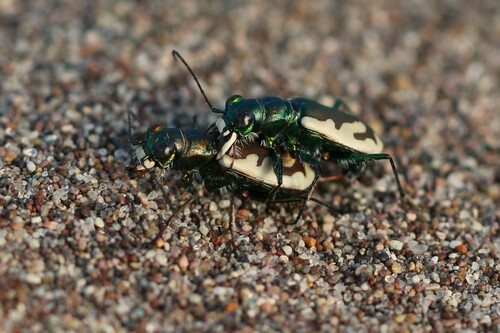


Colorado Dune Tiger Beetle
cicindela theatina
The Colorado Dune Tiger Beetle (Cicindela theatina) is a striking, highly specialized insect endemic only to the Great Sand Dunes of southern Colorado. Navigating one of North America's most extreme environments, this vibrant beetle is renowned for its incredible agility and speed. It serves as a keystone micro-predator of the sand dunes, sprint-hunting other small arthropods across the scorching shifting sands. Its existence is a testament to extreme adaptation, living in an environment where surface temperatures can fluctuate wildly.
Hábitat: Found exclusively on the active and semi-stabilized sand dunes of the Great Sand Dunes National Park and Preserve in Colorado.
This beetle is characterized by its brilliant metallic green to bronze-brown elytra featuring broad, creamy-white markings that dominate much of its upper body, helping it blend seamlessly into the sandy background. It is relatively small, measuring roughly 1.1 to 1.4 centimeters in length. It possesses large, bulging compound eyes for excellent vision, long, slender legs built for rapid running, and formidable, sickle-shaped mandibles used to seize prey.
Categoría
InsectosRareza
Common
Peligro
1/5 · Muy bajo
Snaps
¡Sé la primera persona en hacer un snap!
The larvae act like tiny subterranean jacks-in-the-box, anchoring themselves inside vertical burrows with a specialized dorsal hook to pull passing insects underground.
These beetles run so fast that they temporarily go blind; their brains cannot process visual information at such high speeds, forcing them to stop frequently to relocate their prey.
They are endemic exclusively to the Great Sand Dunes of Colorado, meaning they are found naturally nowhere else on Earth.
Utilizes exceptionally long, slender legs to lift its body off the hot sand, reducing heat absorption while running at blazing speeds.
Digs rapid, temporary burrows into the sand to escape extreme midday heat and freezing nighttime temperatures.
Uses large, high-resolution compound eyes to spot tiny prey movements from afar, initiating lightning-fast chase sequences.
Both adults and larvae are voracious predators, feeding on a variety of small dune-dwelling insects and arthropods.
Diferencias por edad: Larvae live in vertical sand burrows and ambush passing prey, whereas adults actively pursue prey on the surface.
Pogonomyrmex occidentalis
The beetle actively hunts and consumes harvester ants that wander onto the open dunes.
Lanius ludovicianus
This predatory bird nests near the dunes and opportunistically preys upon adult tiger beetles.
Aún no hay insignias de rasgos asignadas a este objeto.
Todavía no hay alias listados.
Las colecciones para este objeto aparecerán aquí a medida que se añadan más temas.
Peligro
1/5 · Muy bajo
Todavía no hay notas especiales de seguridad.
La forma más fácil de identificar a Colorado Dune Tiger Beetle es usar la aplicación de identificación de naturaleza Snappit.
1 cm
2-3 cm
0.0001-0.0003 kg
1-2 años
8 km/h
Both adults and larvae are voracious predators, feeding on a variety of small dune-dwelling insects and arthropods.
Found exclusively on the active and semi-stabilized sand dunes of the Great Sand Dunes National Park and Preserve in Colorado.
Acércate para separar los grupos y explorar dónde se ha fotografiado este objeto.
Los snaps recientes aparecerán aquí a medida que se añadan nuevas observaciones.









.jpg&width=800)





