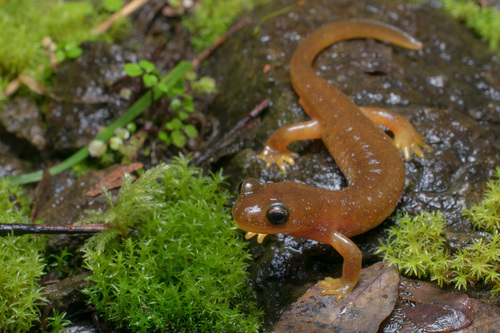


Columbia Torrent Salamander
rhyacotriton kezeri
The Columbia Torrent Salamander (Rhyacotriton kezeri) is a fascinating amphibian endemic to the Pacific Northwest, known for its strong association with cold, fast-flowing mountain streams and seeps. Unlike many salamanders, this species has adapted specifically to the turbulent, oxygen-rich waters of its namesake torrents, often found hidden beneath rocks and logs on the streambed. Its secretive nature and reliance on pristine aquatic habitats make it a key indicator species for environmental health in its range. These small, stout salamanders are living remnants of an ancient lineage, possessing unique physiological adaptations that allow them to thrive where few other amphibians can.
Hábitat: Found exclusively in cold, clear, highly oxygenated mountain streams, seeps, and springs within coniferous forests of the Pacific Northwest.
This small, stout-bodied salamander typically measures 5 to 7.5 centimeters in total length. Its dorsal surface is mottled brown or dark olive, often with small, darker spots, providing excellent camouflage against stream substrates. A distinctive feature is its bright yellow to yellowish-green ventral surface, which contrasts sharply with its darker back. It possesses relatively short, strong limbs, a short, laterally compressed tail, and prominent, squarish parotoid glands located behind its eyes. The eyes themselves are relatively large and protuberant, contributing to its alert appearance.
Categoría
AnfibiosRareza
Common
Peligro
1/5 · Muy bajo
Snaps
¡Sé la primera persona en hacer un snap!
The genus name 'Rhyacotriton' means 'torrent newt', a nod to their preferred fast-flowing aquatic habitats.
Their larvae can take up to 4 years to metamorphose into adults, a remarkably long development period for a small amphibian.
They are unique among salamanders for having internal fertilization but laying eggs externally.
Torrent salamanders are considered 'lungless' because their lungs are greatly reduced, relying almost entirely on cutaneous respiration (breathing through their skin).
Their flattened bodies and robust limbs allow them to navigate and cling to surfaces in strong currents, preventing them from being swept away in fast-flowing water.
Possessing significantly reduced lungs, they primarily breathe through their skin, demanding constant access to highly oxygenated water to survive.
Adapted to survive in extremely cold water environments, they are intolerant of even slight increases in water temperature, making them sensitive to climate change.
The Columbia Torrent Salamander is a carnivorous predator, primarily feeding on small aquatic invertebrates found within its stream habitat. They are opportunistic hunters, consuming whatever small creatures they can ambush.
Anisoptera larvae
The salamander's eggs and larvae can be consumed by predatory aquatic insects, impacting their reproductive success.
Thamnophis sirtalis
Juvenile and adult salamanders are prey for various snakes that forage along stream banks.
Plecoptera larvae
As a predator, it consumes various small invertebrates, playing a role in regulating their populations in stream ecosystems.
Oncorhynchus mykiss
Certain species of trout are opportunistic predators of small amphibians, including young torrent salamanders, if they are encountered in open water.
Aún no hay insignias de rasgos asignadas a este objeto.
Todavía no hay alias listados.
Las colecciones para este objeto aparecerán aquí a medida que se añadan más temas.
Peligro
1/5 · Muy bajo
Todavía no hay notas especiales de seguridad.
La forma más fácil de identificar a Columbia Torrent Salamander es usar la aplicación de identificación de naturaleza Snappit.
5-7 cm
0.002-0.005 kg
5-8 años
The Columbia Torrent Salamander is a carnivorous predator, primarily feeding on small aquatic invertebrates found within its stream habitat. They are opportunistic hunters, consuming whatever small creatures they can ambush.
Found exclusively in cold, clear, highly oxygenated mountain streams, seeps, and springs within coniferous forests of the Pacific Northwest.
Ambush
2-16
Acércate para separar los grupos y explorar dónde se ha fotografiado este objeto.
Los snaps recientes aparecerán aquí a medida que se añadan nuevas observaciones.
















