






common beargrass
Xerophyllum tenax
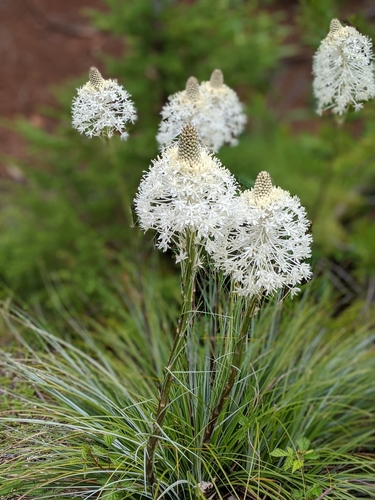
Common beargrass is a tall plant with long, grassy leaves and beautiful white flowers. It grows in sunny places and can be found in many forests and meadows.
Hábitat: Forests
The common beargrass has stiff, grass-like leaves that form dense clumps, often growing up to a meter tall. In summer, it shoots up a tall stalk topped with a dense cluster of creamy-white, star-shaped flowers, making it stand out brightly in mountain meadows.
Categoría
PlantasRareza
Common
Peligro
1/5 · Muy bajo
Snaps
¡Sé la primera persona en hacer un snap!
It only blooms every few years, but when it does, it produces thousands of tiny flowers!
It's not a true grass; it's a member of the lily family, despite its grassy appearance!
Its tall white flower stalks can sometimes grow taller than an adult person!
The plant was named 'beargrass' because bears are sometimes seen foraging near it!
Common beargrass can survive wildfires by resprouting from its deep rhizomes, helping it quickly recover and thrive in burned areas.
It has tough, waxy leaves and deep roots to conserve water, letting it survive in dry, sunny mountain habitats for a long time.
Its incredibly strong, fibrous leaves were historically used by indigenous peoples for crafting durable baskets, mats, and clothing.
Bombus occidentalis
visits flowers to collect nectar and pollen
Odocoileus hemionus
occasionally browses its tough, fibrous leaves
Ursus americanus
may dig up and eat the starchy rhizomes
Cervus elaphus
sometimes feeds on its foliage in mountain meadows
Las plantas con flores son cualquier planta que produce flores como parte de su ciclo reproductivo.
Las plantas de floración de verano producen sus flores durante la temporada estival, a menudo aportando un color vibrante cuando muchas otras plantas ya han terminado de florecer.
Las plantas similares a la hierba son plantas herbáceas que se asemejan visualmente a las verdaderas hierbas, típicamente con hojas largas y estrechas.
Las flores fragantes emiten un aroma agradable, a menudo para atraer polinizadores o como defensa.

Esta característica de uso humano identifica especies que producen fibras naturales, utilizadas por los humanos para textiles, cuerdas, papel y otros bienes manufacturados.

Describe plantas que son particularmente atractivas y beneficiosas para una amplia variedad de organismos polinizadores.

Los hábitats boscosos son entornos terrestres dominados por una densa cubierta arbórea, que sustentan una gran diversidad de vida animal y vegetal.
Todavía no hay alias listados.
Peligro
1/5 · Muy bajo
Always look but don't touch wild plants unless an adult says it's safe.
50-150 cm
30-60 cm
0.5-1 cm
Late spring to summer
No
Ninguna
Perenne
Insectos
Acércate para separar los grupos y explorar dónde se ha fotografiado este objeto.
Los snaps recientes aparecerán aquí a medida que se añadan nuevas observaciones.
British Columbia, CA
Puedes ver Common Beargrass, Subalpine Larch y Mountain Bog Gentian.
Ver guía →
British Columbia, CA
Puedes ver Common Beargrass, White-Flowered Rhododendron y Glacier Lily.
Ver guía →


















