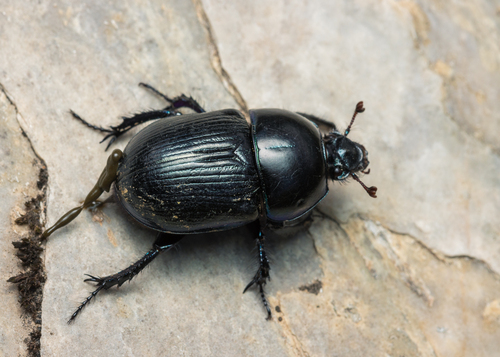


Common Dor Beetle
geotrupes stercorarius
The Common Dor Beetle (Geotrupes stercorarius), also known as the lousy watchman, is a heavy-bodied and ecologically vital beetle native to Europe. This species is famous for its role as a nature recycler, performing the critical task of breaking down and burying animal dung. By excavating deep tunnels beneath dung piles, they aerate the soil, facilitate nutrient cycling, and reduce the breeding grounds of pestilent flies. Their tireless tunneling and waste processing make them unsung champions of pasture ecosystems.
Hábitat: Typically found in pastures, meadows, and open woodlands where grazing livestock are present.
This robust beetle measures between 1 and 3 centimeters in length, featuring a highly convex, oval-shaped body. While its upper side is a glossy black, its underside and the edges of its body display a striking, iridescent metallic violet, blue, or green sheen. The wing cases (elytra) are marked with distinct, deep longitudinal grooves, and its strong legs are heavily lined with spines adapted for digging. Its short antennae are tipped with fan-like, sensory clubs.
Categoría
InsectosRareza
Common
Peligro
1/5 · Muy bajo
Snaps
¡Sé la primera persona en hacer un snap!
Their nickname 'lousy watchman' comes from the fact that they are often covered in tiny, harmless phoretic mites and fly with a clumsy, heavy buzz at dusk.
These beetles are remarkably strong for their size, capable of pushing objects that weigh many times their own body weight.
To provide for their offspring, parent beetles work in pairs to excavate deep tunnels, filling individual side-chambers with a sausage-like mass of dung for each single egg.
Equipped with powerful, spine-covered forelegs, the beetle can rapidly tunnel up to 60 centimeters deep into compacted soil to create underground breeding chambers.
Using sensitive, fan-clubbed antennae, it can detect the faint scent of fresh herbivore manure from great distances, navigating directly to its food source.
When threatened, the beetle can rub its hind legs against its abdomen to produce a distinct, high-pitched squeak to startle potential predators.
Both adults and larvae feed almost exclusively on the dung of herbivorous mammals, recycling nutrients back into the ground.
Diferencias por edad: Larvae feed on dung reserves carefully prepared by the parents in breeding chambers, while adults feed on fresh dung at the surface.
Meles meles
Badgers readily dig up beetle burrows to eat the adult beetles and their plump larvae.
Parasitus coleoptratorum
Mites hitch a ride on the beetle's underside to travel to new dung piles, in turn feeding on fly larvae that compete with the beetle.
Bos taurus
The beetle relies on cattle manure for food and nesting, while its tunneling helps clear the pasture and aerates the soil.
Aún no hay insignias de rasgos asignadas a este objeto.
Todavía no hay alias listados.
Las colecciones para este objeto aparecerán aquí a medida que se añadan más temas.
Peligro
1/5 · Muy bajo
Todavía no hay notas especiales de seguridad.
La forma más fácil de identificar a Common Dor Beetle es usar la aplicación de identificación de naturaleza Snappit.
1+ cm
3+ cm
0.001+ kg
1+ años
8 km/h
Both adults and larvae feed almost exclusively on the dung of herbivorous mammals, recycling nutrients back into the ground.
Typically found in pastures, meadows, and open woodlands where grazing livestock are present.
Acércate para separar los grupos y explorar dónde se ha fotografiado este objeto.
Los snaps recientes aparecerán aquí a medida que se añadan nuevas observaciones.