






Common Five-lined Skink
Plestiodon fasciatus
The Common Five-lined Skink is a small, shiny lizard with five bright stripes running down its body. It loves to bask in the sun and can often be seen darting around in gardens and forests.
Hábitat: Forests
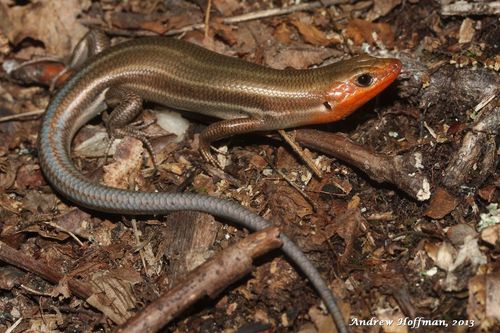
The Common Five-lined Skink has a sleek, shiny body, typically dark brown or gray with five distinct cream or yellow stripes running from head to tail. Juveniles are striking, boasting a brilliant iridescent blue tail that often fades as they mature into adults. Males develop an orange-red head during breeding season.
Categoría
ReptilesRareza
Common
Peligro
1/5 · Muy bajo
Snaps
¡Sé la primera persona en hacer un snap!
During mating season, male skinks flash bright orange-red heads to attract a mate!
Female skinks are amazing mothers, guarding and even cleaning their eggs until they hatch!
Skinks have smooth, shiny scales, making them look almost like they're covered in polished armor!
These skinks are excellent sunbathers, carefully warming up their bodies for energy!
Common Five-lined Skinks can detach their tail when grabbed by a predator, allowing them to escape while the tail wiggles.
Juvenile skinks have a vivid blue tail that likely distracts predators, drawing attention away from their body.
Common Five-lined Skinks can climb trees and structures using their strong claws, helping them find food and evade danger.
These speedy lizards love to munch on all sorts of small insects and other tiny creatures!
Diferencias por edad: As they grow, skinks will eat larger prey items, but their diet remains primarily insectivorous.
Thamnophis sirtalis
A common snake predator in its habitat.
Corvus brachyrhynchos
Birds often snatch skinks from open areas.
Acheta domesticus
A favorite meal of various small insects.

Argiope aurantia
Eats spiders found in its hunting grounds.
Marcado con bandas paralelas o líneas de color.
Los animales solitarios viven solos durante la mayor parte de su vida y solo interactúan con otros para aparearse o cuidar de sus crías.
Los animales arborícolas viven principalmente en los árboles, utilizándolos como refugio, alimento y protección contra los depredadores.
Colorido describe a organismos u objetos que exhiben una amplia variedad de colores brillantes y distintivos.

Este rasgo identifica a los organismos cuya dieta consiste principalmente en insectos y otros pequeños invertebrados.

Los hábitats boscosos son entornos terrestres dominados por una densa cubierta arbórea, que sustentan una gran diversidad de vida animal y vegetal.

Los animales diurnos están activos principalmente durante el día y suelen descansar o dormir por la noche.

Los organismos regenerativos poseen la capacidad de volver a desarrollar partes del cuerpo, tejidos u órganos perdidos o dañados.
Todavía no hay alias listados.
Peligro
1/5 · Muy bajo
Always watch where you step in nature, and don't try to catch wild lizards.
12.5-21.5 cm
0.005-0.015 kg
5-6 años
6.4 km/h
These speedy lizards love to munch on all sorts of small insects and other tiny creatures!
Forests
Foraging
4-10
Acércate para separar los grupos y explorar dónde se ha fotografiado este objeto.
Los snaps recientes aparecerán aquí a medida que se añadan nuevas observaciones.

Virginia, US
Puedes ver Monarch, Tortuga De Caja Oriental y Mariquita Asiática.
Ver guía →

Virginia, US
Puedes ver Summer Snowflake, Lesser Celandine y Mapleleaf Viburnum.
Ver guía →
.jpg)
Virginia, US
Puedes ver Garza Azulada, Fan Clubmoss y Barnacla Canadiense.
Ver guía →

Virginia, US
Puedes ver Rana Verde, Pond Slider y Tortuga Mordedora.
Ver guía →
Virginia, US
Puedes ver Common Five-Lined Skink y Tortuga De Caja Oriental.
Ver guía →
.jpg)
District of Columbia, US
Puedes ver Pato, Ardilla Gris Oriental y Estornino Europeo.
Ver guía →
















