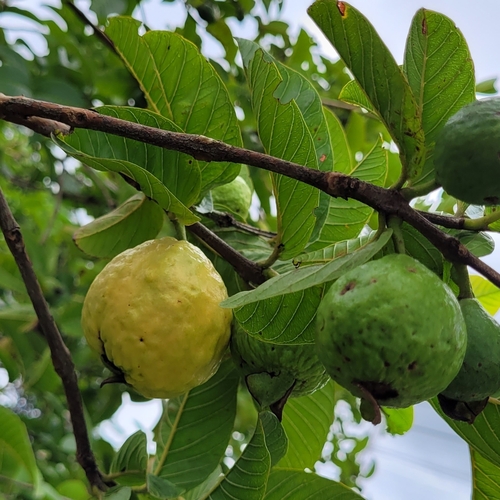


Common Guava
psidium guajava
The Common Guava (Psidium guajava) is a beloved, small tropical tree famed for its delicious, aromatic fruits and outstanding ecological adaptability. Native to the Caribbean, Central America, and South America, this hardy species has spread across tropical and subtropical regions worldwide, valued both for backyard cultivation and commercial orchards. Beyond its agricultural significance, the guava tree plays a vital role in local ecosystems, providing food and shelter for a vast array of birds, insects, and mammals. Fast-growing and resilient, the Common Guava can thrive in a variety of soils, from rich alluvial plains to poor, degraded lands, often helping in soil reclamation efforts. Its leaves and bark have also been used for centuries in traditional herbal medicine, making it a true multipurpose plant.
Hábitat: Found in tropical and subtropical regions, thriving in disturbed areas, open forests, pastures, and agricultural edges.
This evergreen shrub or small tree typically grows up to 10 meters high, characterized by its smooth, copper-colored bark that peels away in thin flakes to reveal a smooth green under-layer. Its leaves are oppositely arranged, elliptical or oval, and exhibit prominent, sunken veins on the upper surface with fine hairs underneath. The highly fragrant flowers are white, about 2.5 cm wide, featuring a cluster of central tufted stamens. The most defining feature is the globose or pear-shaped fruit, which ripens from green to a vibrant yellow, yielding a highly aromatic flesh that can range from pale white to deep pink, studded with numerous small, hard seeds.
Categoría
PlantasRareza
Common
Peligro
1/5 · Muy bajo
Snaps
¡Sé la primera persona en hacer un snap!
A single guava fruit can contain up to four times more Vitamin C than a typical orange, making it an exceptional nutritional source.
Because they can easily spread through seed dispersal by birds and mammals, guava trees can quickly colonize disturbed pastures and native forests, earning them invasive species status in Hawaii and Fiji.
Guava leaves are used in various cultures as a natural toothbrush or chewed to freshen breath and relieve toothaches due to their strong antimicrobial properties.
The tree sheds its copper-colored bark in thin flakes, which helps prevent the accumulation of epiphytes and parasitic vines on its trunk.
Guava leaves release natural chemical compounds into the surrounding soil, which can inhibit the germination and growth of competing plant species.
Its extensive root system allows the plant to access deep water tables, survive dry spells, and rapidly regenerate if the top growth is damaged.
As a photoautotrophic plant, the Common Guava synthesizes its own food using sunlight, water, and carbon dioxide through the process of photosynthesis.
Apis mellifera
Bees visit the fragrant white flowers to collect nectar and pollen, acting as primary pollinators for the tree.
Artibeus jamaicensis
Bats consume the sweet fruits and disperse the seeds across wide areas through their droppings.
Ceratitis capitata
Female fruit flies lay eggs inside the developing guava fruit, where the larvae feed on the pulp.
Aún no hay insignias de rasgos asignadas a este objeto.
Todavía no hay alias listados.
Las colecciones para este objeto aparecerán aquí a medida que se añadan más temas.
Peligro
1/5 · Muy bajo
Todavía no hay notas especiales de seguridad.
La forma más fácil de identificar a Common Guava es usar la aplicación de identificación de naturaleza Snappit.
300-1000 cm
30-50 años
As a photoautotrophic plant, the Common Guava synthesizes its own food using sunlight, water, and carbon dioxide through the process of photosynthesis.
Found in tropical and subtropical regions, thriving in disturbed areas, open forests, pastures, and agricultural edges.
14-28 días
Acércate para separar los grupos y explorar dónde se ha fotografiado este objeto.
Los snaps recientes aparecerán aquí a medida que se añadan nuevas observaciones.