

Common Shiny Woodlouse
oniscus asellus
The Common Shiny Woodlouse (Oniscus asellus) is a remarkably adaptable and widespread terrestrial crustacean. Far from being an insect, this fascinating little creature belongs to the subphylum Crustacea, making it more closely related to ocean-dwelling crabs and lobsters than to beetles or ants. It has adapted exceptionally well to life on land, finding its niche as a vital decomposer in both wild and human-altered environments. By voraciously consuming dead plant material, it plays a crucial role in nutrient cycling, breaking down organic matter and returning essential elements to the soil. Often overlooked as simple garden pests, these woodlice are actually harmless and highly beneficial scavengers. They are incredibly common across Europe and have been introduced to the Americas, where they thrive in moist, dark microhabitats. Observing a Common Shiny Woodlouse provides a direct window into the hidden, microscopic ecosystems of the forest floor and backyard compost heaps, highlighting nature's incredible ability to clean and renew itself.
Hábitat: Typically found in moist, shaded environments such as under rotting logs, stones, leaf litter, and compost heaps in woodlands, gardens, and urban spaces.
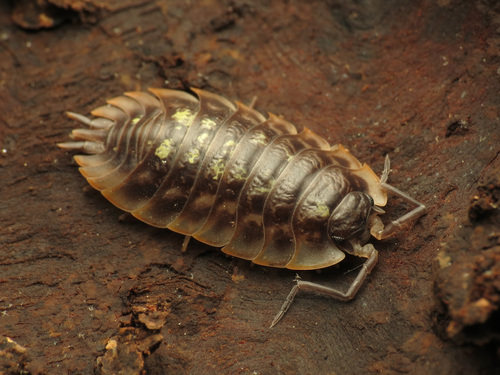
The Common Shiny Woodlouse is relatively large and flat, reaching up to 16 millimeters in length. As its name suggests, it is characterized by a glossy, shiny dorsal exoskeleton that typically ranges from dark grey to brown. The shell is often decorated with distinct paler, yellowish mottling, and the edges of its segmented armor form a continuous, light-colored "skirt" around its body. Unlike pillbugs, Oniscus asellus cannot roll itself into a tight defensive ball; instead, it relies on staying flat and clamping down against surfaces. Its head features moderately long, sharply angled antennae with three flagellar segments at the tip, which helps distinguish it from similar species.
Categoría
AnimalRareza
Common
Peligro
1/5 · Muy bajo
Snaps
¡Sé la primera persona en hacer un snap!
Because they breathe using modified, gill-like structures called pleopodal lungs, they must live in damp environments to prevent these 'gills' from drying out.
Unlike the familiar pillbug, the Common Shiny Woodlouse cannot roll up into a ball; if threatened, its main defense is to clamp down incredibly tight against a flat surface.
Woodlice are terrestrial crustaceans, meaning they are more closely related to crabs, shrimp, and lobsters than to insects or centipedes.
Woodlice have copper-based blood utilizing hemocyanin rather than iron-based hemoglobin, which makes their blood appear pale blue when oxygenated.
Instead of urinating liquid waste, woodlice conserve water by excreting their nitrogenous waste as ammonia gas directly through their exoskeleton.
They can accumulate and tolerate high levels of heavy metals like copper and zinc in their hepatopancreas, allowing them to survive in heavily polluted environments.
Females develop a fluid-filled marsupium (brood pouch) on their underside where they carry and protect their eggs and newly hatched young until they are ready to emerge.
They primarily consume dead and decaying plant matter, playing a critical role in nutrient cycling and soil health.
Diferencias por edad: Newly hatched young, called mancas, consume the same decaying matter but often eat their mother's feces to establish the necessary gut microbiome to digest woody material.
Dysdera crocata
Preyed upon specifically by specialized spiders with large fangs designed to pierce their tough exoskeleton.
Bufo bufo
Consumed by small amphibians foraging in the leaf litter during the night.
Sorex araneus
Eaten by small, highly active insectivorous mammals scurrying across the forest floor.
Aún no hay insignias de rasgos asignadas a este objeto.
Todavía no hay alias listados.
Las colecciones para este objeto aparecerán aquí a medida que se añadan más temas.
Peligro
1/5 · Muy bajo
Todavía no hay notas especiales de seguridad.
La forma más fácil de identificar a Common Shiny Woodlouse es usar la aplicación de identificación de naturaleza Snappit.
1 cm
0.00005-0.00015 kg
2-4 años
They primarily consume dead and decaying plant matter, playing a critical role in nutrient cycling and soil health.
Typically found in moist, shaded environments such as under rotting logs, stones, leaf litter, and compost heaps in woodlands, gardens, and urban spaces.
Foraging
20-60
Acércate para separar los grupos y explorar dónde se ha fotografiado este objeto.
Los snaps recientes aparecerán aquí a medida que se añadan nuevas observaciones.




