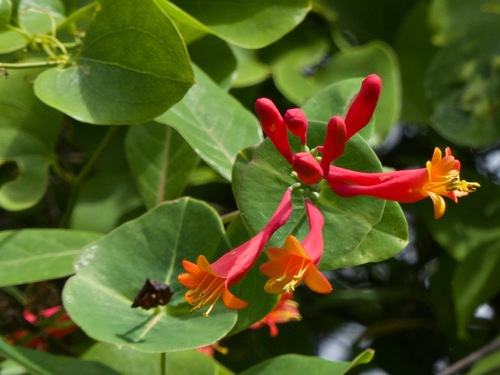


Coral Honeysuckle
lonicera sempervirens
Coral Honeysuckle (Lonicera sempervirens), also known as trumpet honeysuckle, is a stunning evergreen to semi-evergreen woody vine native to the eastern United States. Celebrated for its breathtaking clusters of narrow, tubular red-and-yellow flowers, this vigorous climber is a favorite of gardeners and wildlife enthusiasts alike. Unlike its highly invasive relative, the Japanese honeysuckle, Coral Honeysuckle is non-invasive and plays a vital role in supporting local ecosystems. It climbs gracefully by twining its stems around supports, draping fences, trellises, and native shrubs in vibrant color from spring through autumn. Beyond its ornamental charm, Coral Honeysuckle is an ecological powerhouse. It serves as a major nectar source for migrating hummingbirds and a larval host for several beautiful moth species. Its glossy, dark green leaves are paired or fused around the stem, providing excellent structure. Towards the end of the season, the vibrant flowers transition into bright red berries that sustain songbirds through the autumn and winter months.
Hábitat: Found in open woodlands, pine flatwoods, forest edges, clearings, and along roadsides and fencerows.
This woody climbing vine features slender, twining stems and pairs of opposite, oval-shaped leaves that are glossy green on top and glaucous blue-green underneath. The most distinctive foliage feature is the uppermost pair of leaves, which are fused together around the stem to form a single, circular disc. The striking tubular flowers grow in whorled clusters of four to six, showcasing a bright coral-red exterior and a contrasting yellow interior. As the flowers fade, they are replaced by small, shiny, translucent red berries that cluster tightly together.
Categoría
PlantasRareza
Common
Peligro
1/5 · Muy bajo
Snaps
¡Sé la primera persona en hacer un snap!
Scentless by Design: Unlike the highly fragrant, invasive Japanese honeysuckle, native Coral Honeysuckle flowers have almost no scent because hummingbirds, their primary pollinators, hunt by sight rather than smell.
The Trumpet Name: It is frequently called the trumpet honeysuckle due to the elongated, narrow trumpet shape of its bright red-orange blossoms.
Wildlife Lifesaver: During late summer and autumn, its berries provide a critical, moisture-rich energy source for songbirds preparing for migration.
Features bright red, scentless, tubular flowers designed perfectly for the long bills of hummingbirds, providing abundant high-energy nectar.
The upper leaves fuse into a single disc, structurally reinforcing the stem to support heavy flower clusters and acting as a barrier to crawling insect pests.
Climbs without damaging host plants by winding its slender, flexible woody stems around supports rather than using aggressive clinging roots or tendrils.
As a photoautotrophic plant, Coral Honeysuckle synthesizes its own food using sunlight, carbon dioxide, and water through the process of photosynthesis.
Archilochus colubris
Pollinates the flowers while feeding on the rich nectar.
Hemaris diffinis
Uses the plant as a host, with caterpillars feeding on the foliage.
Cardinalis cardinalis
Feeds on the ripe red berries during autumn and winter, dispersing the seeds.
Aún no hay insignias de rasgos asignadas a este objeto.
Todavía no hay alias listados.
Las colecciones para este objeto aparecerán aquí a medida que se añadan más temas.
Peligro
1/5 · Muy bajo
Todavía no hay notas especiales de seguridad.
La forma más fácil de identificar a Coral Honeysuckle es usar la aplicación de identificación de naturaleza Snappit.
300+ cm
10+ años
As a photoautotrophic plant, Coral Honeysuckle synthesizes its own food using sunlight, carbon dioxide, and water through the process of photosynthesis.
Found in open woodlands, pine flatwoods, forest edges, clearings, and along roadsides and fencerows.
Photosynthesis
Acércate para separar los grupos y explorar dónde se ha fotografiado este objeto.
Los snaps recientes aparecerán aquí a medida que se añadan nuevas observaciones.



















_Fraxinus_ornus_-_Flowers_-_Fronton_(Haute-Garonne).jpg&width=800)

