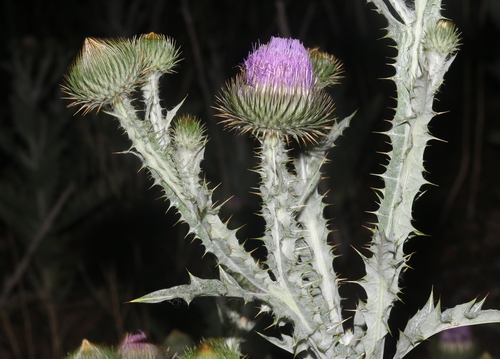


Cotton Thistle
onopordum acanthium
The Cotton Thistle is a majestic and imposing biennial plant renowned for its striking silver-grey appearance and formidable array of thorns. Standing tall as a member of the sunflower family (Asteraceae), it has a rich history and was traditionally chosen as the national emblem of Scotland. It is highly valued in gardens for its dramatic, architectural presence, although in many parts of North America and Australia, it has earned a reputation as an aggressive, invasive weed due to its rapid spreading tendencies in disturbed soils.
Hábitat: Typically found in disturbed areas, dry pastures, roadsides, waste places, and dry fields with sandy or gravelly soils.
This tall, branching biennial can reach heights between 50 to 300 centimeters. Its entire structure is covered in a dense, woolly webbing of white-to-grey hairs, giving the plant a distinctive dusty or cottony appearance. The sturdy stems feature broad, spiny, running wings along their length. Its leaves are large, coarse, and deeply lobed with sharp yellow spines at the margins, while the flower heads are globe-shaped, 3 to 5 centimeters wide, and capped with vibrant purple-to-pink florets surrounded by spine-tipped bracts.
Categoría
PlantasRareza
Common
Peligro
1/5 · Muy bajo
Snaps
¡Sé la primera persona en hacer un snap!
Its scientific name Onopordum translates roughly from Greek to 'donkey flatulence,' originating from an ancient belief that eating the plant caused gas in donkeys.
The Cotton Thistle is the traditional national emblem of Scotland, symbolizing fierce defense due to its painfully sharp spines.
The seeds contain up to 25 percent oil, which was historically extracted and burned in lamps across Europe.
The entire plant is heavily armored with sharp spines along its stems and leaf margins, which effectively deter large herbivores from grazing on its foliage.
A dense covering of white, cottony trichomes reflects excess solar radiation, reduces water loss through transpiration, and protects the plant from harsh, drying winds.
A single plant can produce tens of thousands of seeds that remain viable in the soil seed bank for several years, waiting for optimal germinating conditions.
As an autotrophic plant, the Cotton Thistle produces its own food through photosynthesis, utilizing sunlight, water, carbon dioxide, and soil minerals.
Apis mellifera
Provides abundant nectar and pollen for foraging workers.
Vanessa cardui
Caterpillars feed on the spiny leaves as their primary host plant.
Carduelis carduelis
Adult birds feed on the protein-rich seeds during autumn.
Aún no hay insignias de rasgos asignadas a este objeto.
Todavía no hay alias listados.
Las colecciones para este objeto aparecerán aquí a medida que se añadan más temas.
Peligro
1/5 · Muy bajo
Todavía no hay notas especiales de seguridad.
La forma más fácil de identificar a Cotton Thistle es usar la aplicación de identificación de naturaleza Snappit.
50-300 cm
0.1-2 kg
2 años
As an autotrophic plant, the Cotton Thistle produces its own food through photosynthesis, utilizing sunlight, water, carbon dioxide, and soil minerals.
Typically found in disturbed areas, dry pastures, roadsides, waste places, and dry fields with sandy or gravelly soils.
Acércate para separar los grupos y explorar dónde se ha fotografiado este objeto.
Los snaps recientes aparecerán aquí a medida que se añadan nuevas observaciones.









.jpg&width=800)