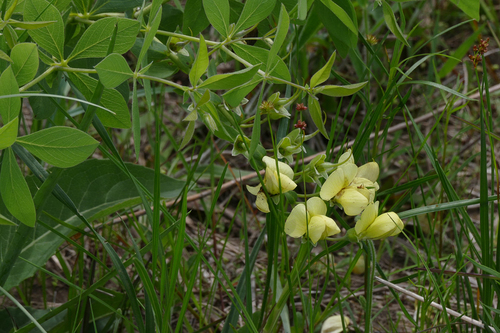


Cream Wild-Indigo
baptisia leucophaea
Cream Wild-Indigo (Baptisia leucophaea) is a stunning perennial wildflower native to the tallgrass prairies and open savannas of North America. Known for its elegant, creamy-yellow pea-like blooms, this resilient plant is a hallmark of high-quality prairie ecosystems. It grows in a distinctive spreading mound, with heavy flower spikes that gracefully arch downward, often resting on the ground. Beyond its beauty, Cream Wild-Indigo plays a crucial role in its native habitat. As a member of the legume family, it improves soil health through nitrogen fixation, while providing vital sustenance for native pollinators, including bumblebees and several specialized butterflies. Over time, the plant develops a deep, woody taproot that helps it survive harsh droughts and wildfires common to the prairie landscape. Observing a mature, blooming cluster in the wild is a true highlight of spring, symbolizing the rich botanical heritage of the American Midwest.
Hábitat: Found in high-quality tallgrass prairies, open oak savannas, glades, and sandy barrens.
This plant typically forms a low, bushy mound up to 80 cm in height. Its most striking feature is the horizontal or downward-arching racemes of pale, cream-colored to butter-yellow pea-like flowers, which bloom in spring. Each leaf is compound and divided into three clover-like leaflets, accompanied by large, leaf-like stipules at the base of the leaf stalks. The stems are covered in fine, velvety hairs, giving the foliage a soft, grayish-green appearance. As the season progresses, the flowers give way to large, inflated, oblong seed pods that mature to a dark charcoal-black color.
Categoría
PlantasRareza
Common
Peligro
1/5 · Muy bajo
Snaps
¡Sé la primera persona en hacer un snap!
Inside the mature, blackened pods, the loose seeds rattle when shaken, giving it the colloquial nickname 'rattlebush'.
The common name 'Wild Indigo' comes from the historic, albeit inferior, use of the genus Baptisia as a substitute for true indigo dye.
When the plant dies in autumn, the entire structure turns black, dries up, and can break off to roll like a tumbleweed, scattering its seeds across the prairie.
Forms a symbiotic relationship with rhizobia bacteria in its root nodules to convert atmospheric nitrogen into a usable form, enriching the surrounding soil.
Develops a massive, woody taproot that penetrates deep into the earth, securing moisture during dry summers and anchoring the plant against prairie winds.
Produces quinolizidine alkaloids throughout its tissues, making the plant highly unpalatable and toxic to most mammalian herbivores.
Generates its own food through photosynthesis using sunlight, carbon dioxide, and water, supplemented by nitrogen fixed from the atmosphere.
Erynnis baptisiae
Serves as a critical larval host plant for this native butterfly species.
Callophrys irus
The caterpillars of this rare butterfly feed on the flowers and developing seed pods.
Bombus pensylvanicus
Provides nectar and pollen to bumblebees, which are strong enough to force open the pea-like flowers for pollination.
Aún no hay insignias de rasgos asignadas a este objeto.
Todavía no hay alias listados.
Las colecciones para este objeto aparecerán aquí a medida que se añadan más temas.
Peligro
1/5 · Muy bajo
Todavía no hay notas especiales de seguridad.
La forma más fácil de identificar a Cream Wild-Indigo es usar la aplicación de identificación de naturaleza Snappit.
30+ cm
Generates its own food through photosynthesis using sunlight, carbon dioxide, and water, supplemented by nitrogen fixed from the atmosphere.
Found in high-quality tallgrass prairies, open oak savannas, glades, and sandy barrens.
Acércate para separar los grupos y explorar dónde se ha fotografiado este objeto.
Los snaps recientes aparecerán aquí a medida que se añadan nuevas observaciones.