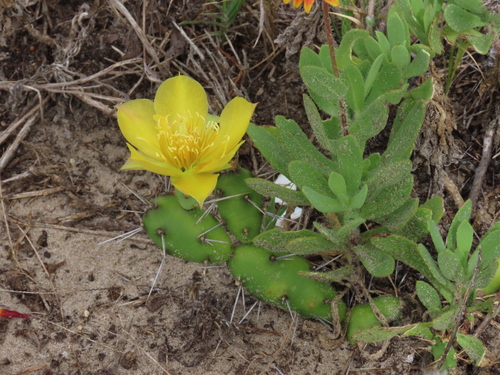


Creeping Cactus
opuntia drummondii
The Creeping Cactus (Opuntia drummondii), also known as the creeping pricklypear, is a low-growing, prostrate cactus native to the coastal plains of the southeastern United States. Unlike its taller relatives, this resilient plant hugs the ground, forming dense, sprawling mats in sandy environments. It is highly characterized by its small, easily detached segments that readily latch onto the fur of passing animals or the footwear of hikers, serving as a clever method of vegetative propagation. In late spring, this rugged survivor brightens its harsh sandy habitats with brilliant, waxy yellow flowers that contrast beautifully with its formidable spines.
Hábitat: Found in sandy coastal dunes, maritime forests, sandy pine flatwoods, and scrub habitats throughout the southeastern United States.
This cactus features flattened, elongated, or cylindrical green to grayish-green pads measuring about 5 to 10 centimeters in length. The pads are armed with formidable, long, yellowish to brown spines (usually 1 to 3 per areole) that can reach up to 5 centimeters long. It grows almost entirely prostrate, rarely rising more than 10 to 20 centimeters off the ground. In spring, it produces large, showy yellow flowers, which are followed by small, fleshy, reddish-purple fruits that are smooth and pear-shaped.
Categoría
PlantasRareza
Common
Peligro
1/5 · Muy bajo
Snaps
¡Sé la primera persona en hacer un snap!
Despite its painful spines, the juicy red fruits it produces are edible and provide vital hydration for coastal wildlife.
It can survive complete burial under shifting sand dunes, slowly pushing new growth upward to reach the sunlight again.
Its segments detach so easily that hikers often refer to them as 'cockspurs' or 'hitchhikers' due to how quickly they cling to ankles.
The stem segments detach with minimal contact, allowing them to hitch a ride on passing animals and root wherever they drop.
It opens its stomata at night to capture carbon dioxide, minimizing water loss during hot, dry days.
The inner tissues contain a slimy mucilage that binds and retains water, allowing the cactus to survive extreme dry spells.
As a photosynthetic plant, the creeping cactus produces its own sugars using sunlight, carbon dioxide, and water absorbed through its shallow root system.
Gopherus polyphemus
The gopher tortoise feeds on the fleshy pads and fruits of the cactus, helping disperse seeds through its droppings.
Diadasia opuntiae
The Opuntia bee is a specialized pollinator that visits the bright yellow flowers to gather pollen and nectar.
Dactylopius coccus
Cochineal scale insects feed on the moisture and sap of the cactus pads, often covering themselves in white, cottony secretions.
Aún no hay insignias de rasgos asignadas a este objeto.
Todavía no hay alias listados.
Las colecciones para este objeto aparecerán aquí a medida que se añadan más temas.
Peligro
1/5 · Muy bajo
Todavía no hay notas especiales de seguridad.
La forma más fácil de identificar a Creeping Cactus es usar la aplicación de identificación de naturaleza Snappit.
10-50 cm
0.1-1.5 kg
10-30 años
As a photosynthetic plant, the creeping cactus produces its own sugars using sunlight, carbon dioxide, and water absorbed through its shallow root system.
Found in sandy coastal dunes, maritime forests, sandy pine flatwoods, and scrub habitats throughout the southeastern United States.
Photosynthesis
Acércate para separar los grupos y explorar dónde se ha fotografiado este objeto.
Los snaps recientes aparecerán aquí a medida que se añadan nuevas observaciones.













