

Creeping Phlox
phlox stolonifera
Creeping Phlox (Phlox stolonifera) is a low-growing, evergreen perennial wildflower native to the forested slopes and damp woodlands of the Appalachian Mountains in the eastern United States. This charming groundcover is highly celebrated for its ability to transform forest floors and garden borders into vibrant, dense mats of color during the early spring. It spreads gracefully via stolons—creeping horizontal stems that root at their nodes—allowing it to colonize shaded areas and stabilize slopes against soil erosion. Its resilience and dense growth habit make it a beloved choice for rock gardens and shade landscaping. Beyond its aesthetic appeal, Creeping Phlox plays an important ecological role by providing early-season nectar for emerging native pollinators, such as long-tongued bees and butterflies. Its sweet, delicate fragrance and lush green foliage add texture and sensory delight to woodland ecosystems throughout its native range.
Hábitat: Typically found in rich, moist, deciduous woodlands, forested slopes, and along stream banks, particularly in the Appalachian region.
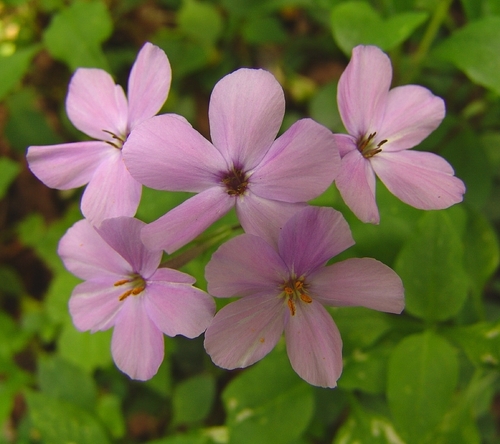
Creeping Phlox is characterized by its mat-forming growth habit, reaching heights of only 10 to 25 centimeters but spreading significantly wider. Its evergreen leaves are oval-shaped, simple, and slightly hairy, measuring up to 7 centimeters in length. During spring, the plant erupts with clusters of five-lobed, tubular flowers that range in color from pastel lavender and violet-blue to pink and occasionally white. Each flower features a small, bright yellow center. The flowering stems arise vertically from the creeping leafy stolons, presenting the blossoms in loose, eye-catching flat-topped clusters that completely blanket the ground.
Categoría
PlantasRareza
Common
Peligro
1/5 · Muy bajo
Snaps
¡Sé la primera persona en hacer un snap!
Its dense, mat-forming growth habit is highly effective at acting as a natural weed suppressant in woodland gardens.
The scientific name 'stolonifera' refers to the plant's stolons, which are runners that creep along the soil surface to spawn new clones.
Unlike many other woodland plants, its foliage remains semi-evergreen to evergreen, providing year-round ground cover even in freezing temperatures.
Uses horizontal, above-ground stems called stolons that easily root at the nodes to quickly carpet shady forest soils.
Retains green leaves throughout the winter months, maximizing photosynthesis in late winter before the deciduous forest canopy closes.
Forms a dense, fibrous root network that effectively binds loose soil on steep, wooded slopes.
As a photoautotrophic plant, it produces its own energy by converting sunlight, water, and carbon dioxide into simple sugars through photosynthesis.
Papilio glaucus
Feeds on the nectar of the spring blooms and helps pollinate the plant.
Odocoileus virginianus
Occasionally browses on the evergreen foliage, especially during lean winter months.
Bombus impatiens
Extracts nectar and pollen from the tubular flowers, assisting in pollination.
Aún no hay insignias de rasgos asignadas a este objeto.
Todavía no hay alias listados.
Las colecciones para este objeto aparecerán aquí a medida que se añadan más temas.
Peligro
1/5 · Muy bajo
Todavía no hay notas especiales de seguridad.
La forma más fácil de identificar a Creeping Phlox es usar la aplicación de identificación de naturaleza Snappit.
10-25 cm
5-10 años
As a photoautotrophic plant, it produces its own energy by converting sunlight, water, and carbon dioxide into simple sugars through photosynthesis.
Typically found in rich, moist, deciduous woodlands, forested slopes, and along stream banks, particularly in the Appalachian region.
Photosynthesis
Acércate para separar los grupos y explorar dónde se ha fotografiado este objeto.
Los snaps recientes aparecerán aquí a medida que se añadan nuevas observaciones.