

Creeping Snowberry
gaultheria hispidula
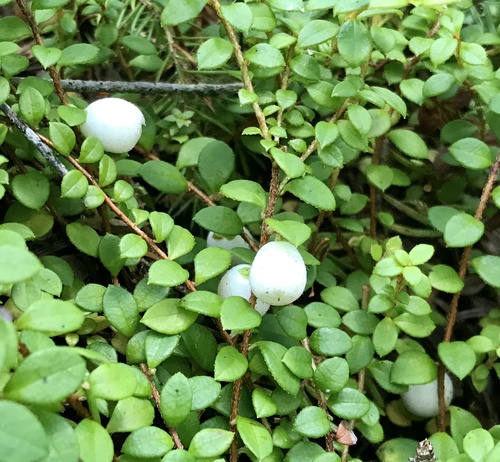
Creeping Snowberry (Gaultheria hispidula) is an enchanting, low-growing evergreen shrub that forms delicate, moss-like mats across the forest floor of northern coniferous woodlands and peatlands. Belonging to the heath family (Ericaceae), this resilient plant is highly specialized for thriving in nutrient-poor, highly acidic environments. It is beloved by naturalists for its tiny, wintergreen-scented leaves and delicate white berries that resemble miniature snowballs scattered across green moss.
Hábitat: Found in damp, acidic boreal forests, forested peat bogs, and coniferous swamps, typically growing over decaying mossy logs and hummocks.
This diminutive creeping plant features slender, trailing stems covered in tiny, brown, bristly hairs. Its leaves are alternate, oval-shaped, evergreen, and extremely small, measuring only 4 to 10 millimeters in length, with distinctive brownish bristles on their undersides. In spring, it produces tiny, solitary, nodding, bell-shaped white flowers. These are followed in late summer by small, fleshy, egg-shaped white berries, which are about 5 to 10 millimeters long and possess a mild wintergreen aroma when crushed.
Categoría
PlantasRareza
Common
Peligro
1/5 · Muy bajo
Snaps
¡Sé la primera persona en hacer un snap!
Both the leaves and the pure white berries possess a bright, refreshing peppermint-wintergreen flavor and aroma when crushed.
Indigenous peoples traditionally used the leaves of this plant to brew an aromatic medicinal tea to soothe sore throats, colds, and headaches.
The species name 'hispidula' is derived from Latin, meaning 'bristly', which refers to the tiny brown hairs on its stems and leaves.
Creeps flat against the ground and over mosses to shield itself from freezing winter winds and to trap moisture and warmth.
Utilizes specialized mycorrhizal fungi in its root system to absorb scarce nutrients from highly acidic, peat-rich soils.
Produces methyl salicylate (wintergreen oil) throughout its tissues as a natural deterrent against insect pests and pathogens.
As a photosynthetic plant, it generates its own energy from sunlight, carbon dioxide, and water while utilizing specialized root fungi to absorb minerals from nutrient-poor soil.
Sphagnum capillifolium
The plant grows directly within and on top of peat moss mats, which provide critical moisture and support in acidic soils.
Bonasa umbellus
The white, wintergreen-flavored berries are an important seasonal food source for forest birds.
Tamiasciurus hudsonicus
Small mammals forage on the berries and help to disperse the seeds through the forest floor.
Aún no hay insignias de rasgos asignadas a este objeto.
Todavía no hay alias listados.
Las colecciones para este objeto aparecerán aquí a medida que se añadan más temas.
Peligro
1/5 · Muy bajo
Todavía no hay notas especiales de seguridad.
La forma más fácil de identificar a Creeping Snowberry es usar la aplicación de identificación de naturaleza Snappit.
10-100 cm
5-25 años
As a photosynthetic plant, it generates its own energy from sunlight, carbon dioxide, and water while utilizing specialized root fungi to absorb minerals from nutrient-poor soil.
Found in damp, acidic boreal forests, forested peat bogs, and coniferous swamps, typically growing over decaying mossy logs and hummocks.
Acércate para separar los grupos y explorar dónde se ha fotografiado este objeto.
Los snaps recientes aparecerán aquí a medida que se añadan nuevas observaciones.