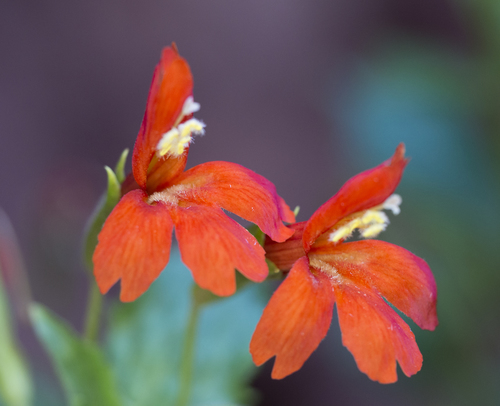


Crimson Monkeyflower
erythranthe verbenacea
The Crimson Monkeyflower is a striking, moisture-loving perennial herb native to the arid canyons of the American Southwest and northern Mexico. Standing out like a brilliant torch against dusty sandstone, this vibrant plant is renowned for its fiery red-orange flowers. It thrives in microhabitats where water is constantly present, such as desert seeps, springs, and weep holes in sheer canyon walls. Its ability to colonize these damp, vertical rock faces makes it a crucial botanical oasis in otherwise inhospitable terrains.
Hábitat: Typically found growing in wet canyon seeps, desert springs, and moist sandstone crevices of the southwestern United States and northern Mexico.
This upright herb typically grows 30 to 80 centimeters tall, featuring sticky, glandular-hairy stems and opposite, oblong-toothed green leaves. Its most defining feature is the array of tube-shaped, brilliant crimson-red to scarlet flowers, which measure up to 5 centimeters in length. The blossoms feature a prominent two-lipped corolla with a yellow, slightly hairy throat that acts as a visual guide for pollinators, contrasting sharply against the intense red petals.
Categoría
PlantasRareza
Common
Peligro
1/5 · Muy bajo
Snaps
¡Sé la primera persona en hacer un snap!
Despite growing in arid, scorching desert regions, this plant is an obligate wetland species, meaning it cannot survive without a constant, direct source of water.
Its scientific genus name, Erythranthe, translates directly from Greek as 'red flower', referencing its vivid blossoms.
The common name 'monkeyflower' comes from the shape of the blossoms, which are thought to resemble a grinning monkey's face when viewed head-on.
Produces vibrant, tubular red flowers rich in nectar that are specifically evolved to attract hummingbird pollinators while excluding most bees.
Employs sticky, glandular hairs across its stems and leaves to deter crawling herbivorous insects and reduce transpiration.
Maintains a highly specialized root system capable of anchoring securely into narrow, vertical sandstone fractures and saturated seepages.
As a photosynthetic plant, it generates its own food using sunlight, carbon dioxide, and water, absorbing essential minerals through its roots.
Archilochus alexandri
Pollinates the bright red flowers while feeding on the plant's abundant, sugar-rich nectar rewards.
Junonia coenia
The plant serves as a host for larval development, with caterpillars feeding on its foliage.
Aphis fabae
An insect pest that feeds on the sap of the plant's succulent, moisture-rich stems and leaves.
Aún no hay insignias de rasgos asignadas a este objeto.
Todavía no hay alias listados.
Las colecciones para este objeto aparecerán aquí a medida que se añadan más temas.
Peligro
1/5 · Muy bajo
Todavía no hay notas especiales de seguridad.
La forma más fácil de identificar a Crimson Monkeyflower es usar la aplicación de identificación de naturaleza Snappit.
As a photosynthetic plant, it generates its own food using sunlight, carbon dioxide, and water, absorbing essential minerals through its roots.
Typically found growing in wet canyon seeps, desert springs, and moist sandstone crevices of the southwestern United States and northern Mexico.
Photosynthesis
Acércate para separar los grupos y explorar dónde se ha fotografiado este objeto.
Los snaps recientes aparecerán aquí a medida que se añadan nuevas observaciones.