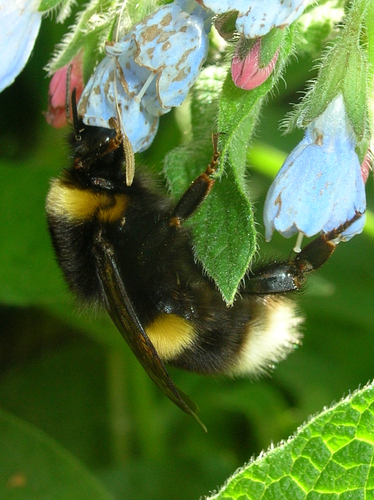


Cryptic Bumble Bee
bombus cryptarum
The Cryptic Bumble Bee (Bombus cryptarum) is a robust and highly industrious pollinator that belongs to the notoriously difficult-to-identify Bombus lucorum species complex. Found across cooler regions of the Northern Hemisphere, this bee gets its common name from its "cryptic" nature—it is visually nearly identical to several of its close relatives. Despite the challenges in spotting it by sight alone, this bumble bee plays an outsized role in sustaining the ecosystems it calls home. Like many of its kin, the Cryptic Bumble Bee is perfectly adapted for cooler climates, emerging early in the spring to forage. They are vital pollinators for a wide variety of wildflowers and shrubs, utilizing specialized techniques like buzz pollination to unlock pollen from stubborn blossoms. Their colonies, though relatively modest in size, are bustling hubs of activity that contribute significantly to the health of heathlands, moorlands, and northern meadows.
Hábitat: Found primarily in heathlands, moorlands, coastal scrub, and cooler boreal or temperate woodlands.
Workers, queens, and males all share a classic 'white-tailed' bumble bee appearance: a relatively large, fuzzy black body intersected by a bright lemon-yellow band just behind the head (the pronotal collar) and a second yellow band across the middle of the abdomen. The tip of the abdomen features a stark white 'tail'. In queens, the yellow collar sometimes extends slightly below the wing bases, occasionally displaying a faint black 'S' shape, though this trait is highly subtle. Because it is nearly indistinguishable from the White-tailed Bumble Bee (Bombus lucorum) and the Northern White-tailed Bumble Bee (Bombus magnus) in the field, definitive identification often requires microscopic examination or DNA analysis.
Categoría
InsectosRareza
Common
Peligro
1/5 · Muy bajo
Snaps
¡Sé la primera persona en hacer un snap!
Because of their incredible cold tolerance, queens are often among the very first bees to emerge from hibernation in the frosty early spring.
The Cryptic Bumble Bee was only recognized as a distinct, widespread species after modern DNA testing proved it was genetically separate from the White-tailed Bumble Bee.
They are a key part of the 'Bombus lucorum complex,' a famous taxonomic puzzle that has frustrated entomologists for over a century.
While foraging, they leave behind tiny scent marks using chemical footprints, letting other bees know if a flower has already been emptied of its nectar.
Vibrates its flight muscles at a specific high frequency to dislodge tightly packed pollen from the anthers of certain flowers.
Capable of shivering its flight muscles to rapidly raise its internal body temperature, allowing it to fly and forage in freezing, early-spring weather.
Possesses a morphological appearance so identical to closely related species that it successfully confounds visual identification by predators and entomologists alike.
Feeds entirely on floral resources, gathering energy-rich nectar and protein-dense pollen.
Diferencias por edad: Larvae are fed a nutrient-dense mixture of pollen and nectar regurgitated by adult workers, whereas adults consume mostly nectar to power their energetic flight.
Calluna vulgaris
Pollinates early-blooming heath and moorland plants.
Misumena vatia
Preyed upon by ambush predators waiting camouflaged on flowers.
Bombus bohemicus
Nests are sometimes usurped or parasitized by social parasites.
Aún no hay insignias de rasgos asignadas a este objeto.
Todavía no hay alias listados.
Las colecciones para este objeto aparecerán aquí a medida que se añadan más temas.
Peligro
1/5 · Muy bajo
Todavía no hay notas especiales de seguridad.
La forma más fácil de identificar a Cryptic Bumble Bee es usar la aplicación de identificación de naturaleza Snappit.
1-2 cm
2-3 cm
0.0001-0.0008 kg
0-1 años
15 km/h
Feeds entirely on floral resources, gathering energy-rich nectar and protein-dense pollen.
Found primarily in heathlands, moorlands, coastal scrub, and cooler boreal or temperate woodlands.
Acércate para separar los grupos y explorar dónde se ha fotografiado este objeto.
Los snaps recientes aparecerán aquí a medida que se añadan nuevas observaciones.










.jpg&width=800)





.jpg&width=800)

